People ask me which curriculum we use for the kids. The honest answer is several, which tends to disappoint them.
I reach for trusted, established systems – the proven ones, built by people who understand their corner of this far better than I ever will. I use each for the one thing it's genuinely good at, and I hold the whole lot together with a fairly stubborn sense of what I want it to build.
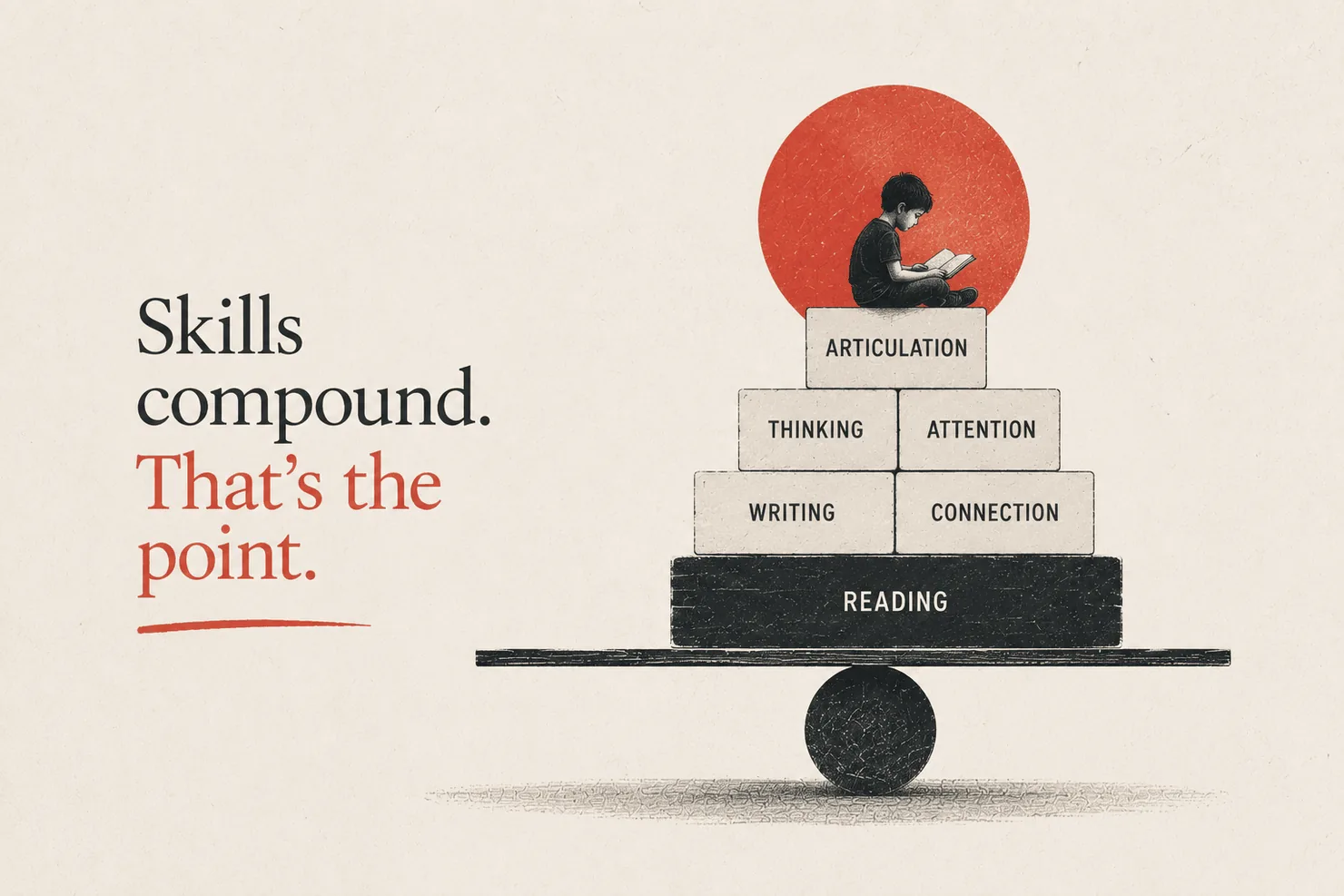
We like to say education is preparation for adulthood. I've come to think it's closer to keeping a balance sheet. Every useful skill a child picks up raises the value of every skill already sitting there.
So the thing I actually care about is a short list. Reading, writing, articulation, thinking, attention, connection, and the ability to get an idea out of your own head and into someone else's intact. That's it. They're the skills I'd bet on for the next twenty years, and they compound in a way subjects don't. A child who reads well learns everything else faster. A child who can hold their attention on one hard thing can hold it on anything. So I don't build curriculum from scratch, or schedules, or timetables. I build a system, and I organise it around the handful of skills that lift all the others.
Writing is the one on that list I know from the inside, which is why I lean on it as hard as I do – possibly harder than is reasonable. I still think with a pen. Most of what I write starts as handwritten outlines, post-it notes, cards in a Zettelkasten box, my hand moving before my head has quite caught up, the writing turning out to be where the thinking happens rather than a tidy record of thinking that happened somewhere more dignified. It would be a strange thing to build a system for my children that treated as optional the one skill I lean on hardest to have a mind at all.
And it isn't only sentiment, though there's plenty of that. Writing by hand engages the brain far more widely than typing does – high-density EEG studies show markedly more connectivity across the regions tied to memory and learning – which is a good part of why handwriting, copywork and dictation stay in the mix long after a screen could do the job faster. There's a gap of my own in here too. I struggle to say out loud what I can put on a page in minutes, and I'd rather narrow that in them than hand it down.
In practice, I'll admit, it still looks like subjects. Maths, STEM, Language Arts. Because a real Tuesday morning has to be run by an actual human being, and you cannot hand a nine-year-old "transferable skills" on a whiteboard and expect breakfast to survive it. The underlying skills are the operating system. The folders on the desktop are still, stubbornly, subjects.
Under each folder sits a small stack of things chosen on purpose, none of them a complete system, most borrowed from people who would be faintly appalled to share a shelf. Maths pulls Singapore for mastery and number sense, Kumon for fluency and discipline, and Synthesis for collaborative problem-solving. They prop each other up: fluency makes the hard problems approachable, and the problem-solving gives all that arithmetic somewhere worth going.
Language Arts is where it gets properly eclectic, and yes, I know how this sounds. We split phonics, grammar, dictation, narration, copywork, reading, discussion and writing into separate jobs, then find the best tool we can for each – vintage spelling books, Cambridge English, carefully chosen literature, a pile of audiobooks. The list looks sprawling. The aim underneath it is almost embarrassingly narrow: vocabulary, comprehension, attention, empathy and, above all, the same thing again – getting an idea out of your own head and into someone else's intact. Art lives here too, filed under visual communication rather than decoration.
Every component earns its slot. I'm choosing for the skill, never the syllabus.
Two of those choices show how it actually runs, whining and all. My son loathes Kumon. Genuinely hates it, complains about it most mornings, would drop it tomorrow if I let him and never look back. We keep it, because nothing else I've found builds the executive-function muscles quite like it does – managing his own time, preparing, getting himself to the desk and through the pile without me hovering behind him. The whining isn't a reason to stop. It's the sound of the muscle working. My daughter loves the same box. She came to reading slowly, would happily have gone on inventing her own stories off the page forever, and Kumon was part of what met her where she was. Same tool, two children, two completely different reasons it earns its place.
Music we run almost backwards to the usual order. We do it for the brain as much as the melody, but most theory is slow and joyless, and – I say this as someone who played three instruments as a child, sat the theory exams, and retained approximately none of it – it rarely survives into adult life anyway. So we skipped the grind and started by ear. Piano, and violin for my daughter, played for the sheer fun of it, letting the love of the thing turn up first and the scaffolding come later, if at all. That order doesn't trouble me in the slightest.
The rest we hack fairly shamelessly. I am a sucker for a good adaptive learning system, the kind that meets a child at their exact edge and keeps nudging it forward, and where those exist for maths and science my son has used them to race through the material – and through a few odd subjects nobody planned on – far faster than any timetable would have allowed. A surprising amount of the rest happens after lights-out. He'll take a bedtime story over almost anything, and I bless "Sleepy History" for wandering off into the origins of tea one night and Cleopatra the next. Half of what he knows seems to have arrived while he was meant to be falling asleep.
The part that makes the whole thing actually work, though, is pace. Nothing in this house moves at one speed. A child can be years ahead in one thing and taking his sweet time in another, and nobody waits for the group, because there is no group. My son runs well ahead where he's ready, and the weight I put on communication suits him exactly – it gives his more advanced work somewhere to go, someone to explain itself to, a reason to become an argument and not just an answer. A year-group classroom, for all its genuine strengths, structurally cannot do this. Thirty children have to move together or the timetable falls over. One kitchen table can let two children move at four different speeds before breakfast.
None of this runs on vibes, though I'd forgive you for assuming it might. I'm confident enough in how I build and navigate systems. But confidence isn't evidence, and I want to know how this one actually performs, not how it feels to run it. So I benchmark. I run side-by-side comparisons against Cambridge, against international standards, against the private schools down the road I could be sending them to instead. Partly to catch the gaps a homemade system will inevitably have. And partly because a person who builds her own system is exactly the person who will tell you, with total sincerity, that it's working. The comparison isn't there to make me feel good. It's there to show me where I'm wrong while there's still time to do something about it.
A few things we lean on hard and don't apologise for. We aren't teaching programming at this age – I care far more that they can think in systems and use technology as leverage than that a nine-year-old can write a loop. We teach executive function on purpose, rather than crossing our fingers and hoping it wanders in on its own. And the body gets real weight, not as a break from the thinking but as the thing that holds it up. Underneath all of it runs an idea the children have absorbed almost without noticing: that skills are collectable, that you stack them the way you'd hoard a favourite set of toys, and that the one with the biggest, oddest, best-fitting collection tends to win.
I should say the obvious thing before you try any of this at home. This is an operating system built for two particular children, and the component list is the least transferable part of it. Yours should look nothing like mine. The parts were never the point.
What transfers is the principle underneath them. You choose every piece for the skill it builds, not the syllabus it covers, and you let the skills compound. Reading makes writing better. Writing sharpens thinking. Thinking improves judgment. Judgment helps you choose what to learn next. None of them grow alone – each raises the return on the rest. It's the balance sheet I started with, every new skill lifting the value of the ones already there.
Which is why I don't much care whether an idea comes from Singapore, a Victorian spelling book, Cambridge, Kumon, a bedtime audiobook or something I dug out of an obscure paper at an hour I won't admit to. My loyalty isn't to any curriculum. It's to the person all those pieces are building between them.
Which is also, in the end, why I stopped caring whether the books are beautiful. There are exquisitely designed curricula that build very little, and ugly photocopied worksheets that change a child's life. Beauty isn't capability. And capability, given time, becomes confidence – the thing that gives a child the nerve to learn the next thing, solve the next problem, and eventually build a life no curriculum could ever have fully prepared them for anyway.
← Back to Notes