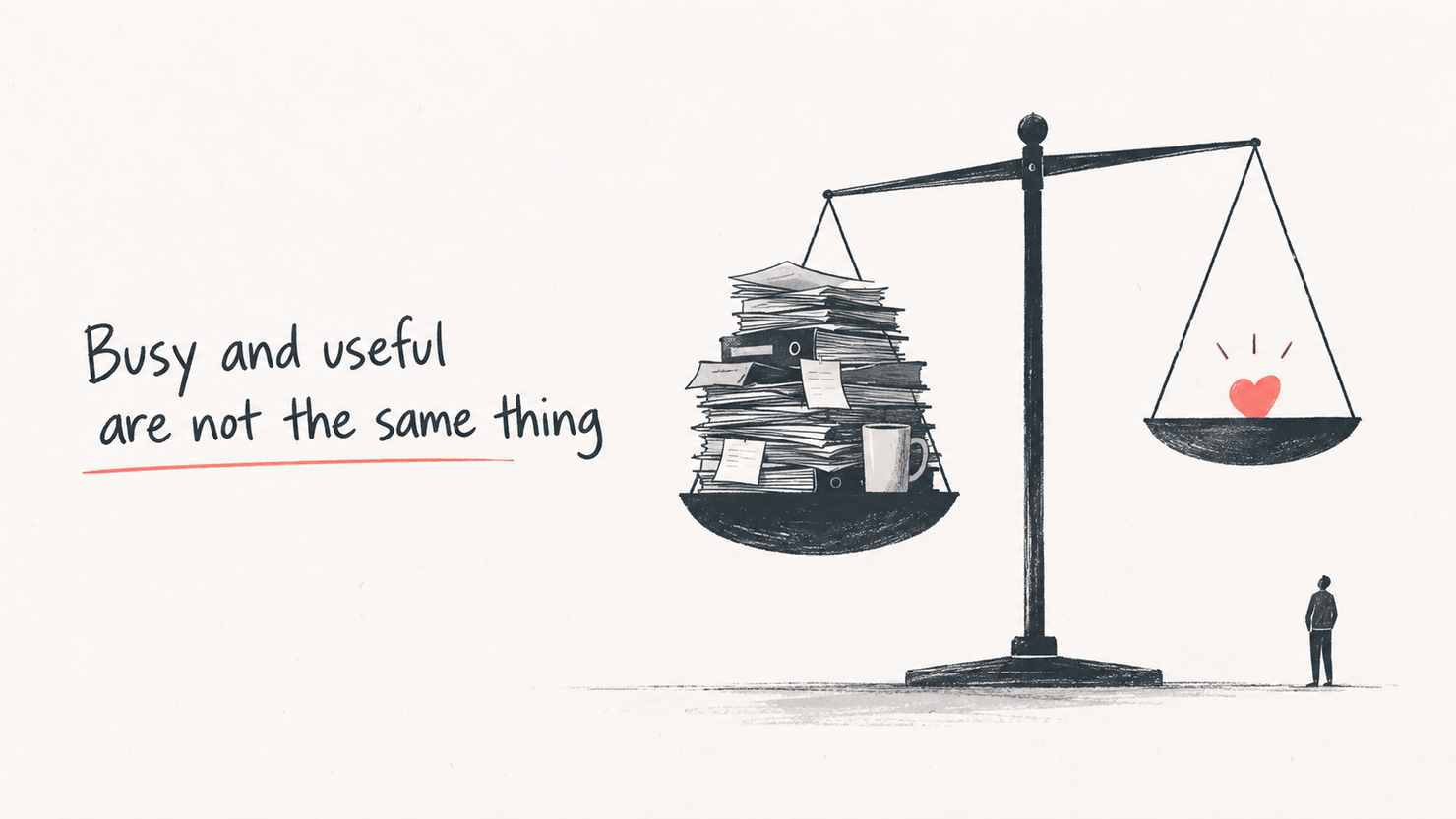
Most of us are very good at being busy.
We fill our days. We clear our inboxes, attend our meetings, ship our tasks, hit our metrics. We optimise. We produce output. We stay on top of things, or we try to, and the trying itself becomes the job.
But busy and useful are not the same thing. And I think we know this – we just prefer not to look at it too directly.
Here's the uncomfortable version of the question: at the end of a given day, week, year – have you produced more than you've consumed? Not just economically. In total. Your attention, your ideas, your decisions, your presence in other people's lives. Did you add more than you took? Did you leave things better, or just leave them used?
For most of us, most of the time, the honest answer is: probably not yet.
That's not an accusation. It's just true. It's true of me on plenty of days. It's true of most well-intentioned people operating at the speed that modern life demands. Useful is genuinely hard. Busy is easy.
The reason I keep coming back to usefulness as a guiding force – rather than success, or impact, or legacy – is that it resists gaming. You can game metrics. You can inflate success. You can manufacture the appearance of impact without the substance.
Usefulness is harder to fake. It either helps someone or it doesn't. The person on the other end knows. You know. There's no dashboard for it, no vanity metric to chase. That's exactly what makes it worth aiming at.
I build things. I acquire things. I teach things, sometimes. And the filter I keep returning to – imperfectly, inconsistently, but still – is: does this help someone? Is this solving a real problem for a real person, or is this me doing something I find interesting and hoping that's enough?
Often it's somewhere in between. That's the honest answer.
The net contribution question is the one that makes people most uncomfortable, I think, because it asks you to count things that don't normally get counted. Your output includes the code you shipped, yes. But it also includes whether you were honest with someone when it would have been easier not to be. Whether you spent thirty minutes helping a person think through a hard decision, and it actually helped. Whether the product you built helped someone who would have spent time doing something tedious.
It's not a spreadsheet. You can't tally it. But you can feel it, roughly.
Usefulness is also not a grand gesture. That's a trap. We think contributing more than we consume means building something huge, or publishing something important, or doing something that compounds into a legacy. Sometimes it does. More often it doesn't.
More often it's the small, consistent, unglamorous things. The answer that was accurate even when the accurate answer was less impressive. The product that does what it promises. The email that said the thing nobody else had said. The thing built with care for the person on the other end, rather than for the metric on the dashboard.
Usefulness compounds. Mostly because people remember. They remember being genuinely helped. They tell other people. They come back. They trust you with more things.
I think about this a lot in the context of building Indiemaker. The question isn't whether it's a good business, though that matters. The question is whether it makes something genuinely easier for the person using it. Whether it creates real liquidity for real people who've built real things and want to hand them to someone else. Whether it reduces friction in a market that currently has too much of it.
Try to be useful. Not as a brand strategy. Not as a legacy project. Just as the basic standard against which you measure a day's work.
It's hard to clear that bar consistently.
But ultimately useful wins.
← Back to Notes