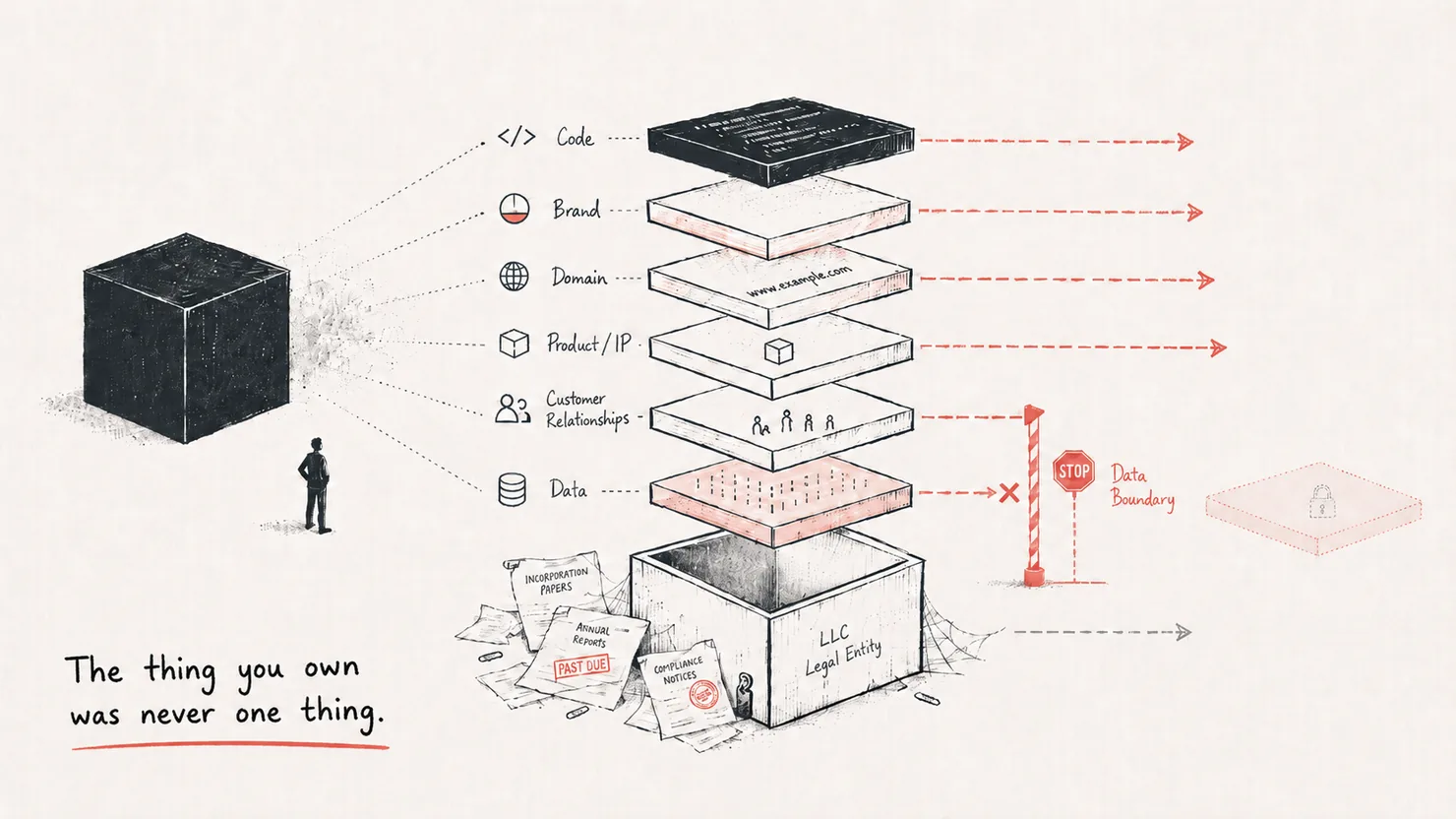
A founder asked me a question in person the other day. He was thinking about founders and small teams who'd spent time on startups that hadn't taken off, were ready to walk away, and wanted to know whether there was any way to sell what they'd built – given they'd never even registered a company. Could services be created to legitimise these projects before a sale, he asked, to make them more valuable?
At first I couldn't see why you'd need to. After turning it over for a day or two, I realised the question points at something most people have backwards about what ownership even is. So here is my answer.
There's a quiet assumption underneath most small exits, and it's wrong. People think selling a business means selling the business – the company, the entity, the thing with a registration number and a bank account and two years of filings behind it.
Most of the time that's the hardest possible way to do it. And often at the smaller scale, it isn't what changes hands at all.
Ownership isn't one thing. It's a stack. The legal entity sits at the top, and underneath it are the things that actually have value – the code, the brand, the domain, the customer relationships, the intellectual property, the data. People talk as if owning the company means owning all of that as a bundle. It doesn't. It means you're the one who happens to be holding the bundle right now. The layers can be separated. And the value almost never lives in the layer everyone's looking at.
The entity is usually the least valuable part and the most painful to move. A company carries history. Liabilities, tax position, contracts, whatever the founders did or didn't file. Buying it means buying all of that, sight unseen, forever. Which is why experienced buyers so often don't. They buy the assets and leave the shell behind.
This is the move M&A people learned a long time ago and the indie world is still catching up to. You don't acquire the company. You strip out what's worth owning – the IP, the product, the users, the brand – and you take that. The entity stays where it is, to be wound down or forgotten by the people who built it. Same value transferred. None of the buried history.
It's the reason "we never registered a company" stops being a problem the moment you see it clearly. If the asset was never the entity, then not having an entity costs you nothing. The code is still IP. The users are still a relationship. The two years of understanding are still real. You were always going to sell the layer underneath. The shell was never the point.
But there's one layer that doesn't move freely, and it's the one people forget until it stops them at the border.
Data.
You can transfer code anywhere. You can assign a trademark across an ocean. But personal data – real people's names, emails, behaviour – doesn't travel like that. If those people are in the EEA, their data can't simply be handed to a buyer in a country with weaker protections. The law treats moving it across a border as a thing that needs a lawful basis and a proper mechanism, not a thing that happens automatically because money changed hands. The asset is sellable. The data inside it might not be sellable to just anyone, anywhere.
And here's the part that makes data the genuine exception in the stack. With every other layer, the "take the asset, leave the entity" move works – it's the whole point. With data it doesn't. The restriction is on the act of moving the data across the border, not on how you structured the deal. You can buy the assets, skip the company, do everything cleanly, and the data still can't follow you home unless the right mechanism is in place. The one layer you can't tidy away by being clever about structure is the one made of actual people.
So the same asset has a different worth depending on who's standing across the table and which border they're behind. A product with a heavily European user base is worth more to a European buyer who can take the data cleanly than to one overseas who'd have to untangle a transfer mechanism first – or strip the data out and lose half of what they were buying. The thing didn't change. The geography of the buyer did.
The US plays the same game by different rules. There's no single federal law policing data at the border – the constraint is state law, California's the one that bites. Move personal information as part of a deal and it generally isn't treated as a "sale" the way handing it to an advertiser would be. But the data arrives with strings attached. As of 2025, a buyer in California has to honour the opt-outs the sellers' users already made before the data changed hands. You don't inherit a clean list. You inherit a list plus everyone's prior choices about how it can be used. Different mechanism, same lesson: the data layer carries obligations the code and the brand never do.
This is where it gets interesting rather than just careful. Online properties with wide geographic data change hands constantly, and the smart version of the deal is built around the data layer from the start, not bolted on at the end. Sometimes that means matching buyer to data – keeping a sale within a region where the transfer is clean. Sometimes it means structuring what actually moves so the valuable part transfers and the regulated part is handled separately, or carved out, or migrated under the right mechanism. The people who do this fluently aren't being clever about loopholes. They just understand that ownership is layered, and they price and structure each layer for what it is.
Most founders never get here, because they're still thinking about the company. They see one object to sell and conclude it's too hard, or there's no entity, or it's not worth the lawyers. Meanwhile the person across the table sees five separate things, knows which ones move easily and which ones don't, and builds the deal accordingly.
That's the whole edge. Not capital. Not nerve.
Knowing the thing you're holding was never one thing.
It was a stack. And the layers were always for sale separately.
← Back to Notes