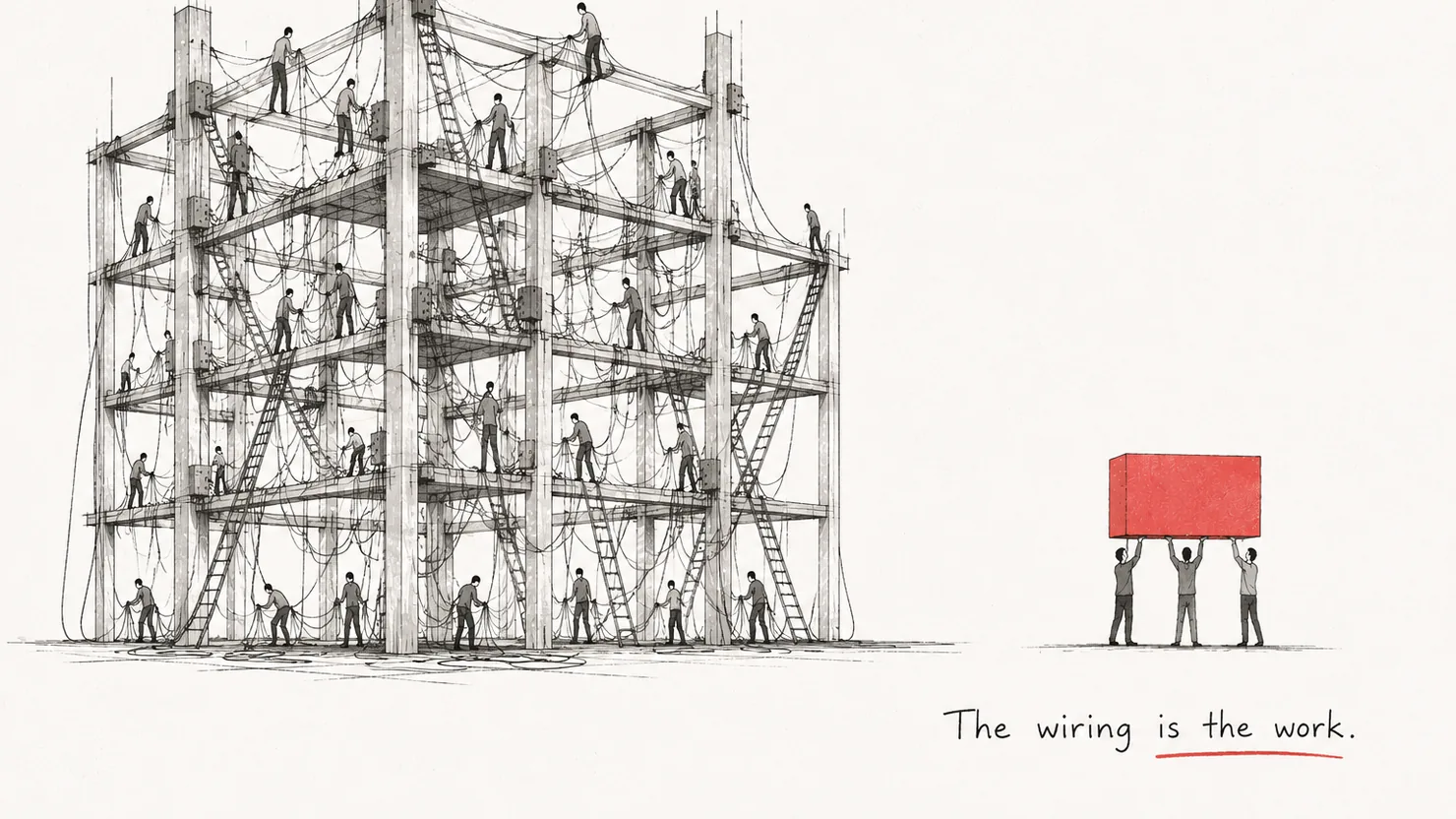
For most of business history, size was capability.
If you wanted to reach more customers, you hired more salespeople. If you wanted to ship more product, you hired more engineers. Wanted to enter a new market, run a campaign, answer the phones – the answer was always more people. Headcount was how you bought the ability to do things.
That equation is quietly inverting.
The things you used to hire for, you can increasingly rent by the hour or wire into a system. Support that ran on a team of twelve now runs on a team of two and a well-built queue. Marketing that needed an agency runs on one operator who knows the tools. The work didn't vanish. The number of humans required to do it collapsed.
This is not a story about working harder or romanticising the solo grind. It's a story about where leverage now lives.
Software is the obvious lever, and the least interesting one to point at. The interesting part is what got cheaper underneath it. Distribution used to be the moat that only big companies could afford – shelf space, ad budgets, a sales force. Now a single person with a clear point of view can reach a global audience for the cost of attention and consistency. The barrier that protected size is mostly gone.
Then there's the cost nobody puts on the balance sheet: coordination.
Every person you add is not just a salary. It's a meeting, a Slack channel, an approval, a handoff, a misunderstanding, a thing that now needs a process. Add enough people and a meaningful share of the company's energy goes into running the company rather than doing the work. Big organisations don't slow down because the people are slow. They slow down because the wiring between the people gets expensive.
A small team barely has that wiring. Three people in a room hold the whole business in their heads. Decisions take minutes, not committees. That speed isn't a personality trait. It's a structural property of being small.
So the advantages stack. Lower coordination cost. Higher leverage per person. Distribution that no longer favours the incumbent. And the work itself reshaped so a handful of people can cover ground that used to need a department.
There's a resilience argument too, and it's the one I'd weight most heavily. A small, profitable team has a low floor to defend. It doesn't need a funding round to survive a quiet quarter. It can sit out a bad market, change direction in a week, say no to the wrong customer. A big team carries a burn rate that demands constant feeding, which quietly removes the option to wait, to refuse, to be patient. Size makes you fragile in exactly the moments patience would have saved you.
None of this is anti-scale. Some problems genuinely need a thousand people and there's no shame in being one of them. This is anti-bloat – against the reflex that the answer to every constraint is another hire, when the constraint is increasingly something a system can hold.
The companies built on that reflex will keep existing. They'll just stop being the obvious shape of ambition.
The future belongs to small teams. Not because small is virtuous, but because the maths finally agrees.
← Back to Notes