It usually starts on the bench at gymnastics. Another mother asks what curriculum we follow, I say we don't really follow one, and there's a small pause – the kind where someone recalibrates who they thought you were. Then the follow-up, almost every time: but why not one of the popular ones? Or, from the more classically minded, why not something properly structured, with Latin and memory work? Or that little tutor centre down the road.
I've learned to brush past it. When someone looks properly puzzled I'll reach for the word tutors, because it ends the conversation faster than the truth does and lets us both get back to watching a seven-year-old fling herself off a beam. But I've been having some version of this exchange for a while, usually while holding someone else's water bottle, and I'd rather write down what I actually think.
I don't start from "which curriculum?" I start from a question that sits much further out: what is this for? My answer, after turning it over – in the car, at the kettle, at two in the morning – is uncomfortably simple. Education exists to increase a child's future agency. Not their happiness this afternoon. Not their grades. Not the satisfying tick of a finished workbook. Agency – the plain, load-bearing kind. Can they think? Can they solve a problem nobody has handed them the method for? Can they read something hard and keep it in their head? Can they learn a thing on their own when I'm not in the room? Can they adapt when the ground moves, which it will? Everything I choose is weighed against that.
The first thing the test exposes is whether a curriculum trusts a child. I've come to believe children badly underestimate themselves, mostly because the adults around them do it first. They are capable of far harder work than we tend to hand them – not misery, not busywork, but the genuinely difficult kind, the kind that makes them go quiet and lean in. This is where I part ways with the models that begin at the wrong end: the ones that front-load memorisation and factual input, and treat recall as the thing a child has to bank before they're allowed to reason. My kids were taught to reason and negotiate since they started talking.
And I part ways just as fast with the models that optimise for a pleasant morning – accessible, prettily presented, gentle on everyone. It's not that gentleness is wrong. It's that quite often a bit of friction is the learning. There is a difference between a child who has many pleasant mornings and one who learns that very often you need to wrestle with something to make progress.
The second thing the test exposes is how a curriculum imagines children learn. Many assume a straight line: this topic, then that one, in a fixed and tidy order. Some march briskly along that line. Others loop back through it in cycles. Either way, when a child lights up over something out of sequence, the usual answer is, "We'll get to that later." I don't believe children learn in lines. They learn in webs. If my son becomes obsessed with Roman engineering on a Tuesday, I'm happy to set the worksheet aside and spend a fortnight on Rome – the arches and aqueducts, the maths that hold them up, the politics that financed them, the empire that outlasted them. A curriculum that has to say "later" to that kind of moment is optimising for its own order, not for the child in front of it. That is also why I choose depth over coverage: let a child go deep into one idea and stay there until it is mastered, instead of circling the same shallow loop year after year. Getting lost in a topic is not a detour from learning. It is learning. I do value clear paths, but I balance them with generous room to follow and work through obsessions like the Romans when they appear.
The third thing the test exposes is what a curriculum is actually counting. Most count what a child knows. This is not my initial focus. I care what a child can do with what they know – whether it transfers, whether it turns up somewhere it was never taught. It's the difference between reciting a fact and using it. This is also why I'm particular about repetition, which people assume I must be against, given all of the above. I'm not. We drill, deliberately and without apology. But I'll drill a thing when the drilling builds a real capability underneath – automatic arithmetic, fluent handwriting, decoding – and I lose interest fast when repetition is only there to lodge a fact that means nothing to the child yet. Repetition in service of a skill, gladly. Repetition in service of recall, rarely.
Underneath all three is the fact that I don't trust any single philosophy that claims to explain the whole of anything. I've never been able to swallow a complete system whole, in education or software or business – I take it apart on the table to see which bits are load-bearing and which are just decoration, which is a tiring way to be and I don't recommend it. I also have some form here: an early part of my career was spent in education marketing, close enough to the machinery to stop believing the pitch. It's left me allergic to the claims schools and curricula make about themselves, and doomed to question every one of them, more or less forever. Most curricula ask for real commitment to their worldview. I'd rather build a portfolio – the best idea for each job, pulled from wherever it happens to live, assembled per child, per subject, per season. None of it came in a box. Most of it is temporary. What my daughter needs this year is nothing like what my son needs right now, and pretending otherwise would make my life tidier and their schooling worse.
I should be honest about the ceiling on all this. I can genuinely admire parts of what I've just rejected. The rigorous classical models do Latin, rhetoric and rich literature better than most, and hold children to a height I respect. The gentle ones are kinder on a bad morning than I sometimes am. And the system I've built is built around two particular children who happen to be curious, driven and able to work alone. I don't know that it would hold for a child who genuinely needs the scaffolding a packaged curriculum gives, and I'm suspicious of anyone – myself first – who designs a system around their own strengths and then calls it universal. It suits mine. That's the only claim I'll make for it.
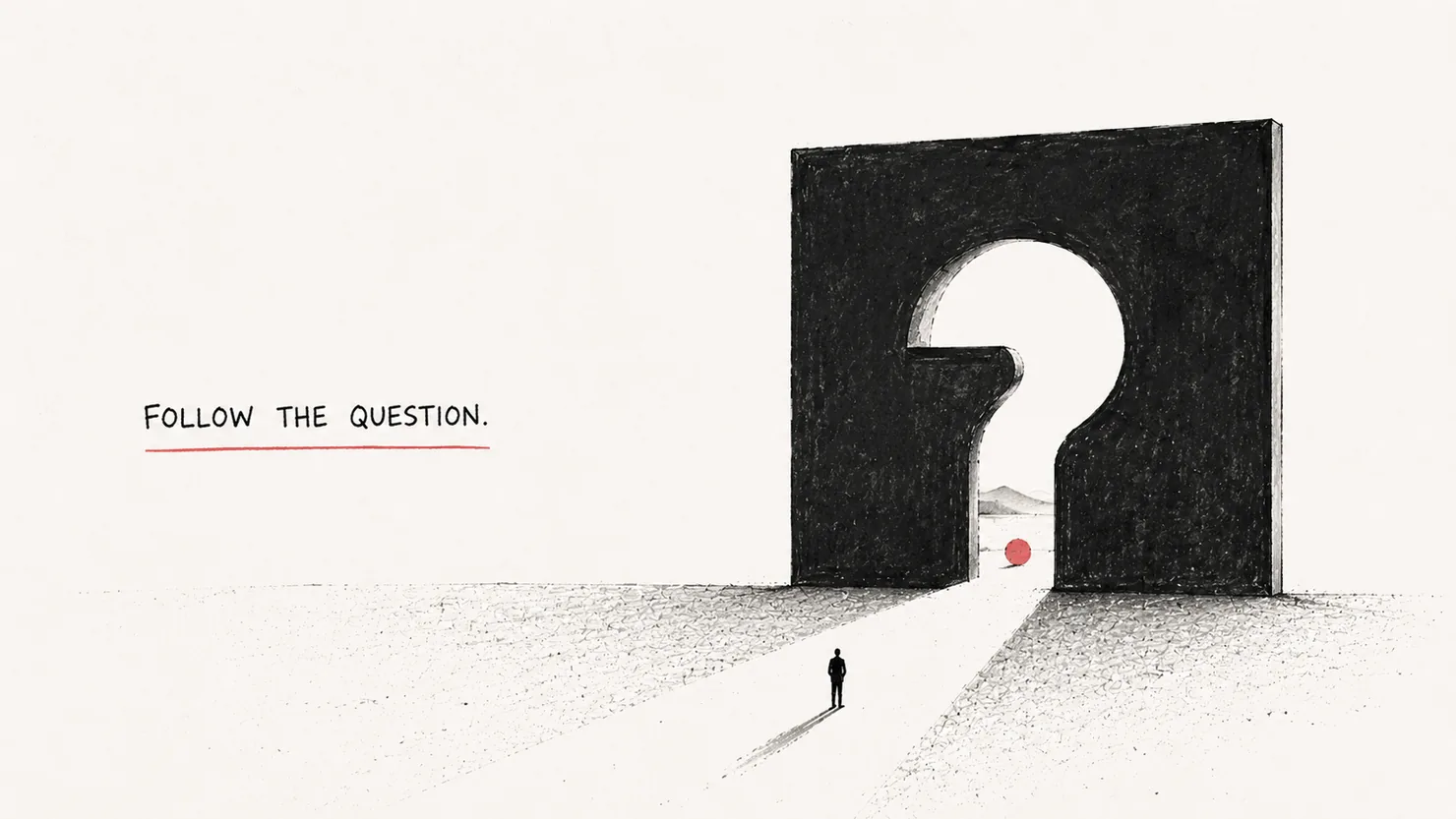
So here's the honest reason I go quiet on the bench. What curriculum do you follow? It has no clean answer. The question I'm actually answering is a different one. The programmes ask what a seven-year-old should know. I'm asking what kind of adult I'm helping a seven-year-old become – a slower, stranger question that doesn't fit between someone's floor routine and the drive home. It's easy to confuse the experience of learning with its outcome. I'd almost never call what we do homeschooling if the word didn't save so much time. It isn't a philosophy I bought. It's a test I keep applying, one child at a time – does this make them more able to run their own life one day? Everything else is packaging.
← Back to Notes