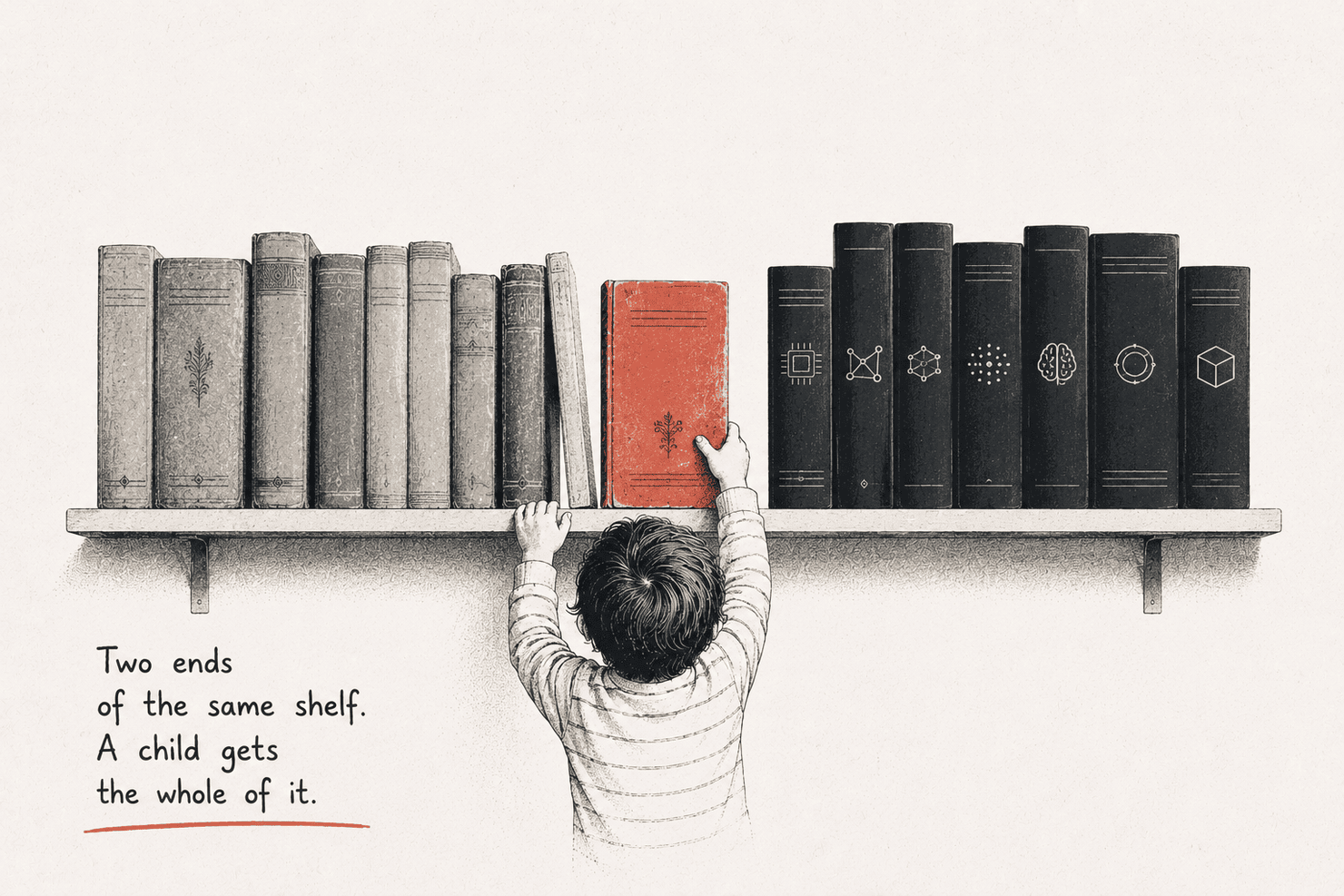
There's a shelf in our house at exactly child height, the one where the sticky fingers reach, and my children keep pulling the oldest book on it. A spelling book, printed around 1900, the paper gone soft at the corners. Not the shiny new one with a cartoon on every page. The old one. Every time, given a free choice, with no nudging from me.
The rest of that shelf makes no sense, and I like it that way. Everything I've been reading about AI and education and where humanity goes next sits at one end. A reading primer, a grammar, and that soft-cornered spelling book from another century sit at the other. Cutting-edge at one hand, hundred-year-old at the other, and I hand my children the length of it.
Here's the thing about the old ones. They assume the child is capable. That's really the whole of it. The vocabulary is richer, the sentences run longer, the expectations sit higher, and there's no apology anywhere for the difficulty, no cheerful voice promising this will be fun. They simply assume you can do this. And children, it turns out, rise to almost exactly the height of the ceiling you build for them. So much of the modern stuff builds the ceiling low and calls it kindness.
Which is where I keep snagging, and I'll admit I don't have a comfortable answer. Somewhere we decided learning had to be fun, and then, without anyone quite noticing, that it had to be entertaining – and those are not the same thing. Fun is what happens when a child gets good at something hard. Entertainment is what you reach for when you've given up expecting that and just need to keep them in the chair. So in comes the cartoon mascot, and the game that eats a whole afternoon to teach what a plain page could have handled in ten minutes. The material gets softer, the learning gets slower, and we call the padding engagement. I keep wondering whether a child taught plainly and completely, with none of the jazz-hands, simply learns the thing quicker and gets to keep more of the afternoon. I'm no longer sure the entertainment helps. I suspect it mostly gets in the way.
The old books also read as though they're trying to teach the world rather than a syllabus. You can feel it on the page. One book is asking what's worth knowing; the other is asking what'll be on the test. The old ones were usually written by one person – some scholar or schoolmaster who plainly never got over the pleasure of a sentence properly parsed – rather than a committee balancing a dozen requirements. More personal for it. More direct. Less optimised, in the way a meal cooked by someone who loves you is less optimised than a supermarket one, and better for it.
Take grammar and spelling, the two things you'd think a curriculum could get right in its sleep. An old English grammar treats the language as one structure and builds it in order: the parts of speech, then how they agree, then how a sentence holds itself together, each chapter leaning on the one before. A spelling book does the same for words. Set that beside how it's done now. In a scheme like Cambridge, grammar and spelling get broken into fragments and sprinkled across the years as little objectives to tick off – a comma here, a suffix there, a rule met once in some term and assumed for good after. Nothing's built as a whole because nothing was ever imagined as a whole. The old book hands you an architecture. The modern one hands you the bricks in a dozen different boxes and trusts the child to notice they were meant to be a wall.
Which is, I think, what mine can feel. There's something to work towards on the page, a sense that the effort is adding up to something, where the new version keeps interrupting itself to check they're still enjoying themselves. And it turns out a child who's getting good at a thing doesn't need asking every thirty seconds whether they're having fun. They care more about the getting-good than the being-entertained. Or maybe it's plainer than that, and a thing just makes more sense once you've been shown the whole of it before someone breaks it into pieces.
They expect attention, too, the old books. They ask a child to concentrate for a stretch and don't apologise for the asking. No font changing every paragraph to keep the dopamine topped up, no illustration dropped in to rescue a wandering eye. Attention as something you build rather than something you constantly bribe – which is the same reason I keep a bit of friction in our days on purpose. A book that never asks for focus never teaches it either.
The old books were also, unmistakably, trying to build a person and not process a student. They cared what kind of adult the child would turn into, whether they could reason, whether they could govern themselves. That's not a curriculum-coverage question. It's the one I keep coming back to.
There's a distinction here I care about, and it's an easy one to miss. This isn't the same as being "child-centred." A lot of modern material adapts itself downward to meet the child where they are. The old books did close to the opposite – they invited the child upward to meet the material. One flatters. The other stretches. I'll take the stretch.
And yes, I know how this sounds. Sit with it if you like – the pinafores, the slates, the cane. Then set it down, because it's the wrong picture, and I'd like to keep the vote and the plumbing and the anaesthetic, thank you. That date range, roughly 1880 to 1920, isn't chosen for its charm. It sits just before we had to work out how to school millions of children at once, and almost everything that came after was an answer to that one enormous engineering problem: standardisation, age-based progression, testing, the machinery you need to move a whole population through a single system. A great deal of what we now call "how education works" is really just how someone chose to scale it. A reasonable choice – I'd probably have made it myself. But a choice, made to fit a constraint, and the interesting thing is that some of those constraints are lifting.
Because if AI takes away the reasons we scaled it that way – the one teacher who can't possibly give thirty children real attention, the impossibility of letting each child move at their own pace – then some of the ideas we threw out for being unscalable are suddenly worth picking back up. The one I want back most is the plainest of them all: that a child can be taught concisely and completely, without the extended drama, and that this is a kindness rather than a coldness.
Which is why the two ends of that ridiculous shelf don't argue with each other. Richer language, real books, narration, mastery, conversation, the slow build of attention – none of it stopped working. It stopped scaling. Put it back in a child's hands, pair it with a tutor that never tires and collaborators anywhere in the world and the ability to make something real by Friday, and you don't get Victorian education. You get something I've no tidy name for yet. I only know that the books I expected mine to tolerate are the ones they choose, and that I've stopped assuming I know which way that arrow points.
← Back to Notes