I spent two years finishing a speech and drama qualification I didn't need, mostly because I'd been in their system for a decade and it felt rude to stop. For years I filed it under wasted effort. Then I went into business and discovered that business is mostly drama. The pitch. The negotiation. The meeting where you keep a perfectly straight face while the projector refuses to work. I've used that qualification more than almost anything else I studied.
It wasn't the only odd piece. I finished high school early with an eclectic set of subjects, including Mercantile Law – a strange choice for a teenager, and one of the most useful things I ever studied once I started reading contracts and doing deals. No thought went into how either would be used. I followed the itch. Weirdly, the two go well together: in business you have to present, and you have to understand the law underneath what you're presenting.
My working life went the same way. An early stretch in education marketing. A promotions company, then a corporate gifting and branding business. Years running a software studio. Buying my first business by wiring money to a stranger. None of it makes sense as a career path, and all of it turned out to be useful. Stack it, and you get someone who can build the software, sell it, read a deal and explain it to a nervous seller, which is more or less the job I have now. The pieces interlock. The odd ones were the point.
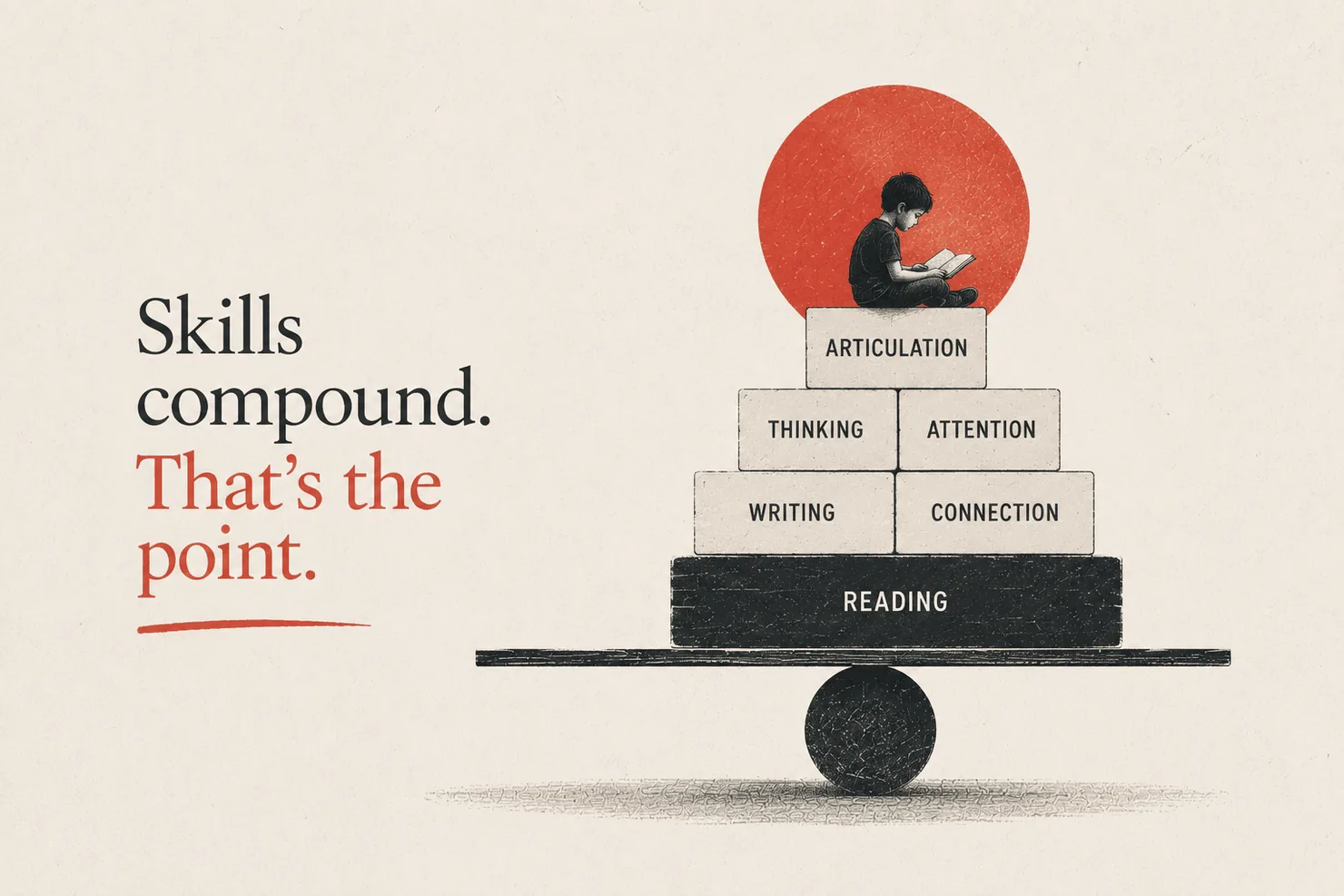
They were pieces in a collection. Skills are collectable. You stack them the way you'd hoard a favourite set of toys. The person with the biggest, oddest, best-fitting collection tends to have the most choices, and choice is most of what independence is.
It's also most of what independent thinking is. A person with one skill sees every problem through it. A person with a dozen odd ones can turn a problem over, look at it from the side, and reach a view that isn't borrowed from whoever explained it last. It's what makes people interesting, too. The most interesting people I know almost always have a strange collection, and you can hear it in how they think.
The world has started rewarding that kind of collection, and fast. AI makes any single skill cheaper every month. I build software with it now, sometimes thousands of changes at a time, and the code stopped being the bottleneck a while ago. What it can't do is choose which pieces to combine, or see the problem from the angle only your particular collection gives you. The combination is the scarce part. AI will help with the law now; it reads a contract faster than I do. It can't stand up in a room and present like a human. That's the drama, still earning its keep.
So if you're young, I'd think about skill stacking differently. Lean into what a machine can't do. And collect widely, because the range of what you know decides how well you can work with it. A machine does what you can describe, and you can only describe what you have the language for. A little film language, a little biology, a working sense of how a contract hangs together – each gives you the words to ask for exactly what you mean. With the work moving under all of us as fast as it is, broad knowledge and the vocabulary of a lot of specialisms have never been more useful.
Some pieces go at the bottom because everything else sits on them. Reading, writing, attention, and the ability to get an idea out of your own head and into someone else's intact. A person who can hold their attention on one hard thing can hold it on anything. I still think with a pen – handwritten outlines, post-it notes, cards in a Zettelkasten box – because the writing is where the thinking happens. When people tell me AI will do their writing for them, I hear that it will do their thinking for them.
The pieces don't all have to be impressive. They have to fit. I played three instruments as a child, sat the theory exams, and kept very little of it. It never connected to anything else I could do, so it fell out of the collection.
When I'm deciding whether a skill is worth adding, for myself and these days for my children too, I ask whether it lifts the others, whether it will survive the job around it changing, and whether it makes a combination that's a little odd. Programming fails the second test at this age; I'd far rather they can think in systems and use technology as leverage than write a loop a machine now writes for them. Writing passes all three, which is why I lean on it hard. At seventeen, drama would have failed all three, which is the other thing the test needs: a little room for the itch.
My son loathes Kumon. He complains about it most mornings and would drop it tomorrow if I let him. We keep it, because nothing else I've found builds the same muscle: managing his own time, getting himself to the desk and through the pile without me hovering behind him. The whining isn't a reason to stop. It's the sound of the muscle working. Executive function passes all three tests, at any age.
The same test works in business. A team is a shared collection, and the useful question about a hire is what their odd pieces add to the ones you already hold.
The children have absorbed this almost without noticing. They talk about skills the way they talk about the things they collect – what they've got, what they're after, what goes with what. I'd like them to keep that habit. I'd like to keep it myself. The jobs will change. The collection comes with them, drama certificate and all.
← Back to Notes