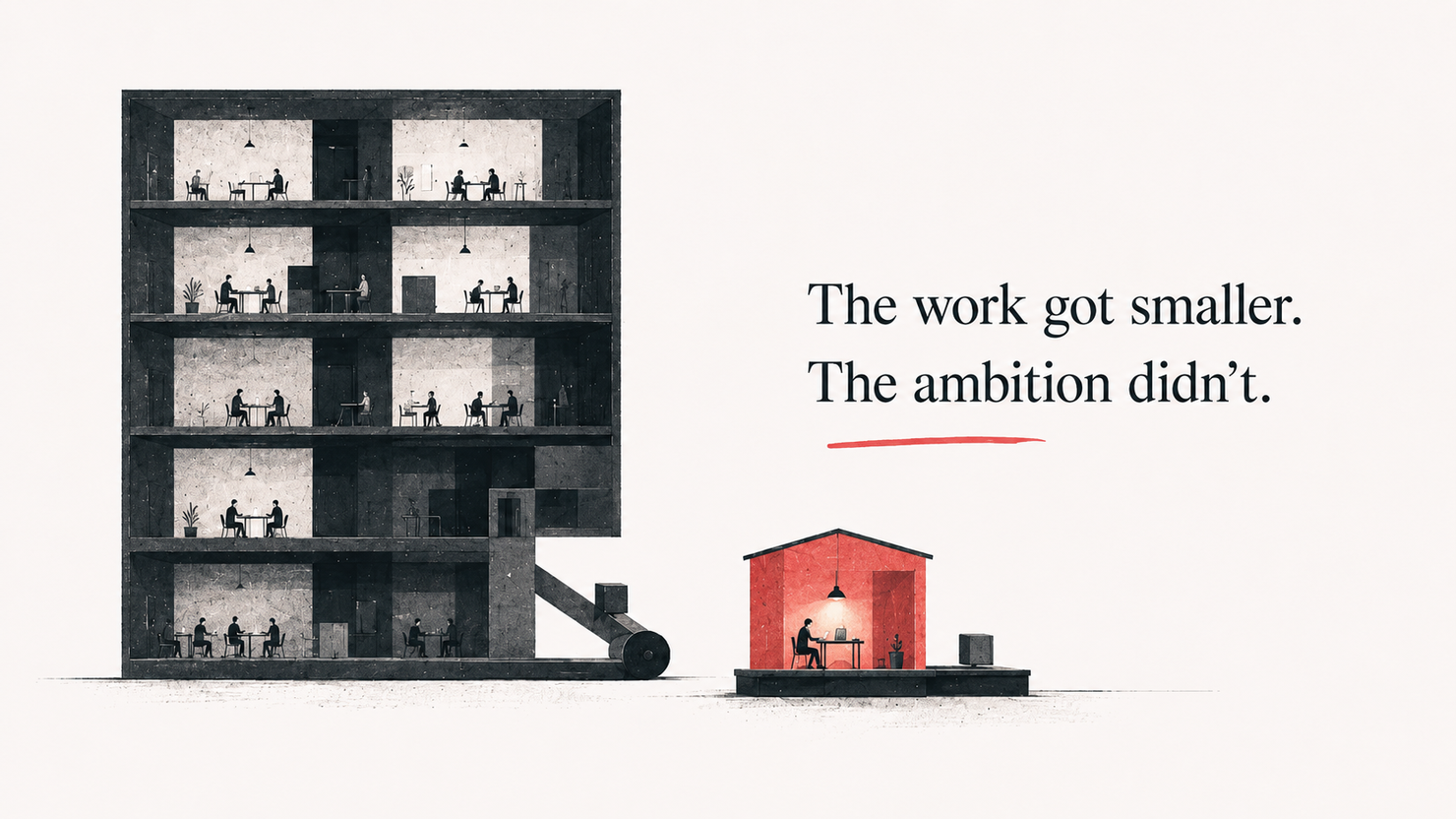
I've believed this since my early tech days. Which, if I'm honest, probably says something about my personality – I've always had a slight bias toward the underdog and a healthy scepticism of anything that requires a lot of people in a room agreeing with each other. Possibly a character flaw. Possibly just good pattern recognition. Either way, I've been making this argument for years, and for most of that time people looked at me like I was being optimistic to the point of delusion.
What's changed is that I'm watching it actually happen.
The cost of building software has collapsed. What used to require a team of five can now be shipped by one person in a few weeks. AI tools are doing real work, not just automating boilerplate. The cost curve is still moving. This doesn't just help small operators – it fundamentally changes who can compete.
At the same time, distribution is fragmenting. The era of winner-takes-all platforms owning all the attention is cracking at the edges. Audiences are scattering into newsletters, communities, podcasts, niche social spaces. For large players trying to reach everyone, this is a problem. For small operators who already have a specific audience's trust, it's an enormous advantage.
Fast-moving, low-overhead operators who own their audience directly are no longer at a disadvantage against well-funded competitors. In many niches, they're ahead. Large organisations are slow by design. They have stakeholders to satisfy, processes to follow, brand risks to manage. A solo operator or a small team can move, test, and adapt in days. When the environment changes quickly – and it does, constantly – that speed compounds.
People sometimes raise Machine Republic as a contradiction. If I believe AI is collapsing the cost of building, shouldn't I be worried about a software studio? I'm not – and I think the reason is worth saying plainly. AI doesn't eliminate the need for people who understand software deeply. It eliminates the need for large teams to produce it. A small, experienced studio that knows how to work with these tools is more competitive now than it was five years ago, not less. The contradiction dissolves when you stop thinking about headcount as the measure of capability.
None of this means that large businesses stop existing. It means the conditions that made them dominant are weakening, and the conditions that favour small, focused, operator-owned businesses are strengthening. The niches that were too small to be worth serving are now commercially viable. The tools to serve them exist. The audiences are findable.
A business that serves 500 people extremely well, with low overheads and a direct relationship with its customers, is a genuinely strong business.
The fact that it's small is not a weakness – it's often the point.
I'm building for this. Indiemaker is predicated on it. The future of digital business is not one big thing – it's thousands of small, well-run assets, built by people who understand what they're building and why. That world is already here. It's just unevenly distributed.
← Back to Notes