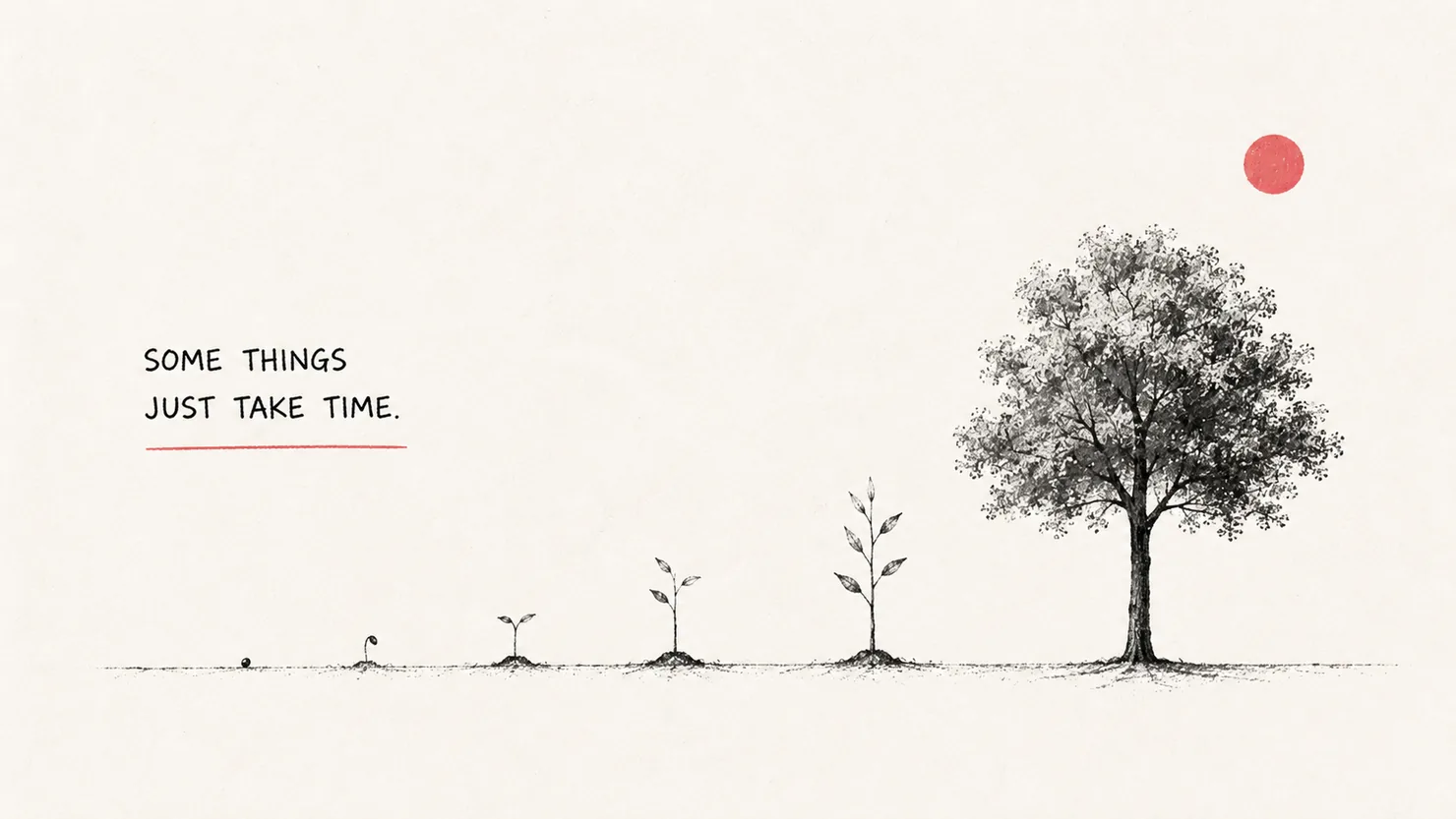
Armin Ronacher wrote something earlier this year that I've been sitting with. The thesis is simple: some things just take time. Not effort, not smarts, not the right tool. Time itself.
He was writing about open source. About how the libraries and ecosystems that the whole industry depends on – the ones that feel like gravity, like they were always there – took years of accumulated decisions, trust, and iteration to become what they are. You can't sprint to that. You can't prompt your way there. You can't acquire it, because nobody is selling it; they're just living it, one commit at a time.
I've built on open source for most of my career. Not just used it – depended on it in the deep, foundational way that makes you realise how much of what you've built is actually standing on the shoulders of people you'll never meet.
Linux servers. Apache and Nginx. PHP and Ruby. MySQL and PostgreSQL. Git. Redis. Rails. Laravel. WordPress. jQuery. Bootstrap. Docker. Thousands of packages installed with a single command and maintained by strangers who asked for nothing in return.
Every company I've built, every product I've shipped, every client project I've delivered has been built on top of that gift.
And nobody conjured that out of a weekend sprint.
The things that hold up under pressure – the libraries, the communities, the ecosystems – held up because they were tested slowly, fixed carefully, and trusted incrementally. Trust compounds the same way interest does: slowly, then faster, then suddenly it looks obvious that it was always going to work out this way.
This is the thing the speed argument tends to skip.
I'm not against speed. I use every tool that makes me faster. But speed compresses execution time. It does not compress the time it takes for something to earn a reputation, grow a community, or build the kind of reliability that makes other people comfortable depending on it.
You can ship faster. You cannot trust faster.
This matters directly to what we're building at Indiemaker.
The bet we're making – the underlying thesis of the whole platform – is that the qualities most affected by time are exactly the qualities that drive valuation in indie acquisitions. Trust. Community. Reputation. A track record. A user base that chose to stay.
These aren't features. They're the foundation. That's what a buyer is actually paying for when they buy a project that works.
The irony is worth sitting with: the thing AI speeds up is building. And buyers are increasingly willing to pay a premium not for what someone built, but for the time someone else already spent. The reputation. The reviews. The community that showed up and decided to stay. The search ranking earned by years of useful content.
You can vibe code a product in a weekend now. You cannot vibe code the three years of credibility sitting underneath an established one.
The acquisition is always, at some level, a purchase of time. Time someone else already spent. The buyer is fast-tracking their way into something they couldn't have manufactured quickly – and the seller is pricing accordingly, because they know what it actually took.
This is why I think the indie acquisition market will hold up even as AI makes building cheaper. Cheaper building means more supply of new projects. It does not mean more supply of projects with five years of user trust behind them. Those are still scarce. And scarce things that people want tend to hold their value.
The flood of fast-built tools will make the patient, compounding things more valuable by comparison. Not less.
The Armin piece is ostensibly about open source, but it's really about a broader principle: that time is not something you can engineer around. You can reduce the time it takes to execute. You cannot reduce the time it takes to earn something.
The projects I value most – the ones I've watched grow, the communities I've been part of, the open source foundations my own work stands on – all of them took years to become what they are. No tool was going to get them there sooner.
Some things just take time.
← Back to Notes