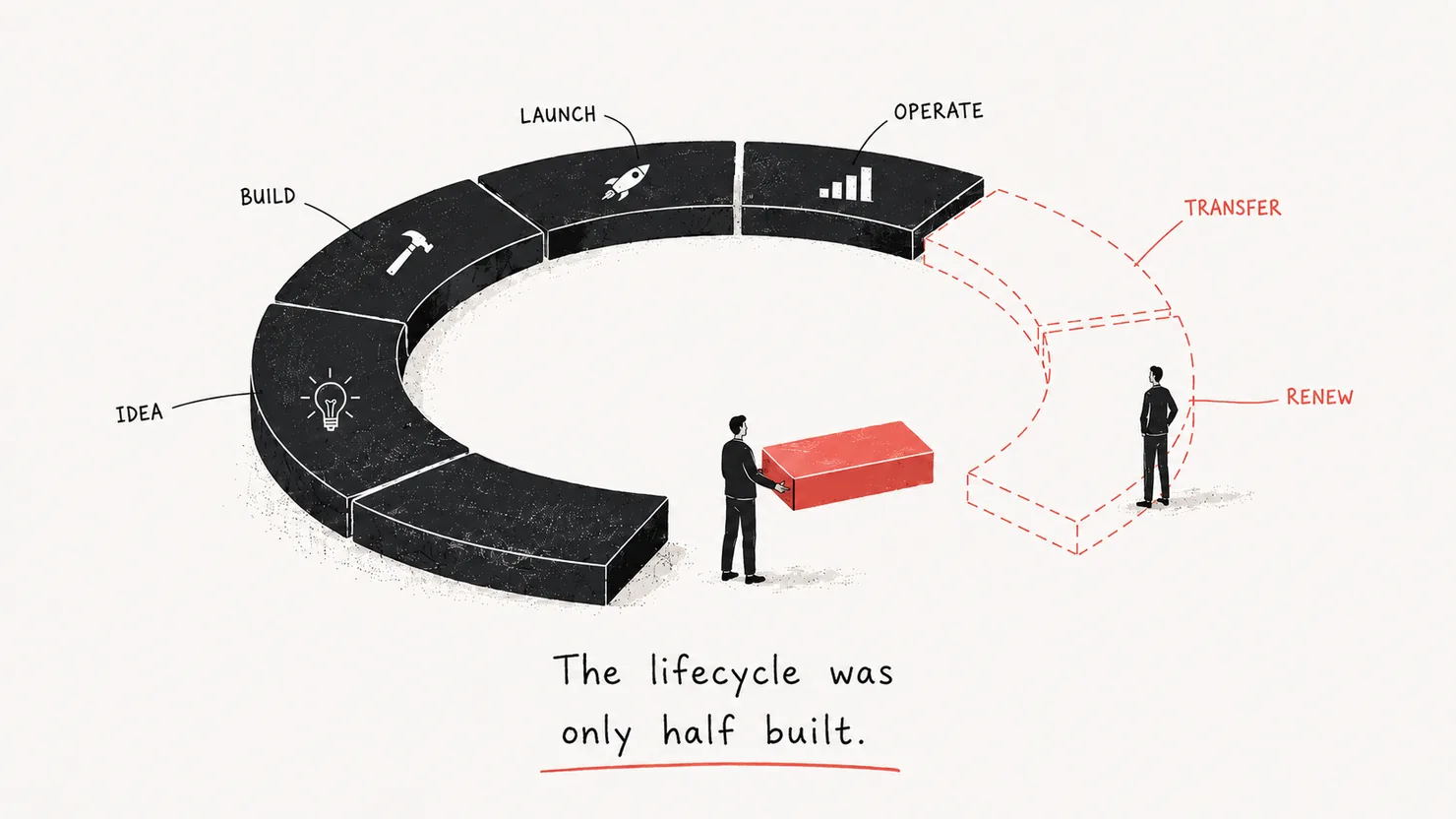
We told a whole generation to build.
Learn to code. Ship the thing. Start the side project. Own your work. It was good advice, and millions of people took it. They built newsletters at the kitchen table, SaaS tools at night, little apps that solved one real problem for a few thousand people who were grateful for them.
We were generous with the starting line. We said almost nothing about how to leave.
Think about what actually happens to most of these businesses. Not the rare ones that get acquired in a headline. The ordinary ones. The profitable little product that the founder has run for six years and is, quietly, exhausted by.
They can't sell it, because there's nowhere obvious to sell it. They can't keep it, because they've changed and it hasn't. So it just sits there, drawing down their attention a little every week, a thing they once loved that now feels like a tab they can't close.
This is the part the build-something story leaves out. Starting is an act of hope. Running, after a while, can become an act of obligation. And without an exit, obligation is where a lot of good businesses go to die slowly.
You've seen the evidence, even if you didn't read it as evidence. The newsletter that posted every week for three years and then went silent with no goodbye. The app still in the store, last updated in 2021, reviews asking if anyone's home. The repository with the thoughtful README and the dead commit history. The domain that lapsed and got snapped up by a parking page.
Each of those was someone's work. Often someone's best work. And almost none of them failed. They were earning, or could have been. The founder simply ran out of road and had no graceful way to hand the keys to someone who'd have driven it further.
That's the quiet tragedy of it. We don't lose these businesses to the market. We lose them to the founder's own life moving on while the business has no door marked exit.
A person can outgrow a company they built. That's not failure – it's the most natural thing in the world. You learn what you came to learn, the season changes, the next idea pulls harder. In any healthy system, that moment is a handover. The builder leaves, the operator arrives, the work continues under new hands.
We never built the handover. We built the front door and forgot the back one entirely.
So founders end up trapped in their own success, or they walk away and let it rot, and both of those are worse than they need to be. Neither is a failure of the founder. It's a failure of the infrastructure around them – the boring, essential machinery of valuing, transferring, and rehoming a small business cleanly.
That machinery is what I'm trying to build. Not because exits are exciting. Because a world that only knows how to start things is a world that wastes most of what it makes.
You should be allowed to put a business down. Someone else should be allowed to pick it up.
We built a world where founders can start but not exit. That second door is overdue.
← Back to Notes