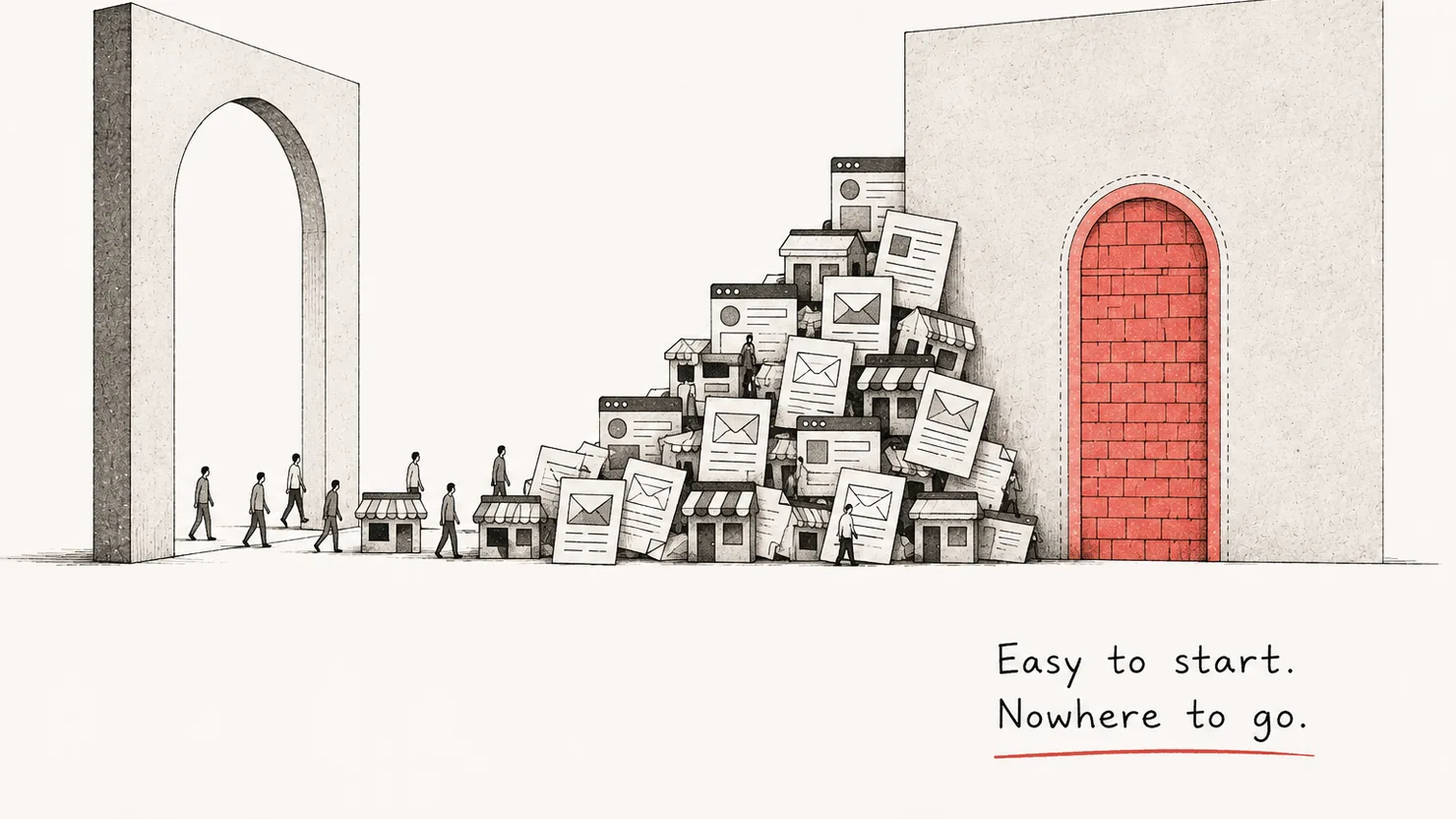
The internet dramatically lowered the cost of starting a business.
What it did not do was lower the cost of leaving one.
Over the past twenty years, millions of people built profitable digital products from bedrooms, spare rooms, coffee shops, and home offices. Small SaaS tools. Browser extensions. Content sites. Niche newsletters. APIs. Tiny ecommerce stores. Mobile apps. Digital utilities that quietly do one thing well and charge a fair price to do it.
Many of these businesses generate real revenue. Some generate life-changing income.
Yet most of them exist in a strange economic blind spot.
Too large to be hobbies. Too small for traditional acquisition markets.
A founder running a $3,000-per-month SaaS product often has no structured path to sell it. A profitable newsletter with 20,000 subscribers may represent years of accumulated trust and distribution – with no obvious liquidity mechanism. A niche directory generating stable affiliate income may quietly produce better returns than many venture-backed startups, while remaining completely invisible to institutional markets.
So an enormous amount of economic value simply disappears.
Projects are abandoned. Domains expire. Repositories go stale. Customers churn away. Years of accumulated goodwill evaporate – not because the businesses failed, but because the founders moved on and had nowhere to go.
Traditional acquisition infrastructure was never designed for this layer of the internet economy. The economics don't work for brokers. The deal sizes are too small for private equity. Venture capital is optimised for scale, not durability. Most financial systems still struggle to classify these assets at all, let alone transfer them cleanly.
But the market itself is growing.
AI tools, global payments, cloud infrastructure, and low-cost software creation are enabling more individuals to operate profitable internet businesses than at any point in history. The number of small digital assets being created is accelerating. The infrastructure to transfer ownership of those assets is not.
This gap is not just friction. It is a structural failure with a real cost – measured in businesses quietly dying that should have had a second life.
The next decade of the internet will not only be about helping people start businesses. It will be about helping them transfer, acquire, operate, and compound them.
The internet created millions of businesses nobody can sell. That problem is worth solving.
← Back to Notes