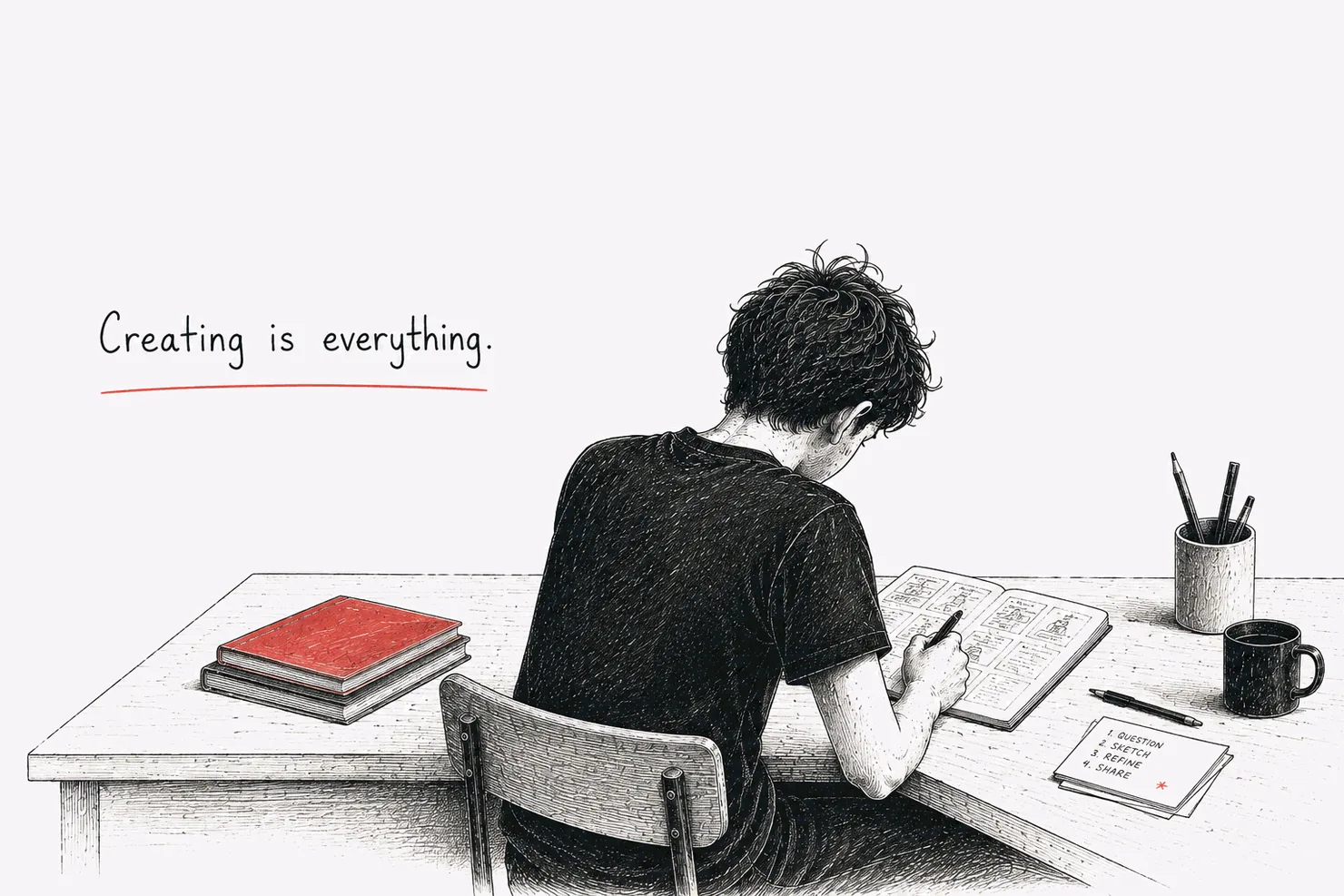
There is a sequence schools run on that is so familiar you stop noticing it was ever a choice. Learn the thing, get tested on the thing, move up a year, and go round again until, at eighteen or twenty-one, you are finally let out to meet reality. School keeps reality waiting until the end. Reality doesn't return the favour – it gets to all of us eventually, ready or not. So from the kitchen table where I teach my two, I build our days around quick cycles: learn something, put it in front of the world in some form, see what reality makes of it, go again. There is nothing clever in that. It is how people have learned for most of human history.
The pattern I keep coming back to isn't a business one, though it borrowed its shape from business. Notice something. Investigate it. Make something. Put that something in front of the world. Watch what happens, and go again. Dan Priestley describes a version of this for entrepreneurs, and reckons the cycles will only get shorter – spot an opportunity, build, launch, learn, repeat, each loop teaching more than the last. He's right that it works. I just don't think the loop belongs to entrepreneurs. It's how a person learns and does almost anything. The business is only the version where you can see the loop most clearly, because at the end someone either bought the thing or they didn't.
Here is the bit that took me an embarrassingly long time to say plainly. The learning isn't hiding in any single trip round the loop. It's in the repetition. A child who makes thirty real things between seven and eighteen – a bird guide for the street, a wobbly first website, a board game whose rules don't quite work until the fourth draft, a newsletter nobody reads for six issues – has gone thirty times round noticing, building, meeting reality and adjusting. That child isn't thirty facts better off. They are a different kind of person. Creating is not the reward for the learning. Creating is the learning, and doing it again is the curriculum.
I want to be careful here, because there is a fashionable version of this that I don't actually buy. The fashionable version says children should start businesses. Mine don't – and I say that as someone who buys and sells businesses for a living, so I am hardly squeamish about the idea. Turning it into "raise little entrepreneurs" shrinks a broad, human thing into a career track, and most children are not going to run companies, nor should they have to. The output of a loop doesn't have to be money. It can be a piece of writing, a scientific question chased into the ground, a play performed for six bored relatives, a bit of open-source code, a broken thing mended, a small event that got a few people into one room. What matters is not that the child sold something. What matters is that they made something that left their own head and met the world – because reality is the only teacher that never softens the mark.
This is also where the future changes the maths. For most of history the cost of trying was high enough that preparation-first made sense. You couldn't let a ten-year-old ship software, design a real product, build a website, write and print a book, so you spent years getting them ready to maybe do those things one day. That constraint has mostly dissolved. A child now can build and ship a working thing in an afternoon, with a tutor that never tires and tools that used to need a whole team and a budget. When the cost of a single loop falls close to zero, the case for spending a childhood getting ready to act – instead of acting, in small real ways, over and over – gets very thin. The rare thing in that world isn't knowing a great deal before you start. It's being willing to start badly and go round again.
I have realised, writing this, that it is the same question I keep circling in the other half of my work, only pointed at a much smaller person. There I ask how capable people turn ideas into things that create value. Here I am asking how a person becomes capable in the first place. Same loop. Same faith that agency is built by making things that meet the world, not by being made ready in a room. One is about economic agency. This one is about the human kind that has to come first.
So there is no projects module in this house, no enterprise unit – God help us. I just try to make sure that fairly often, something one of my children has genuinely thought about leaves the building: gets built, gets shown, gets used, gets judged by something other than me and their reliably impressed grandmother.
My six-year-old is a genuinely good artist, and she wants an art shop. She has tried and failed, over and over, to find a way to sell what she makes. Mostly she gives in, hands a picture over for free, and then announces that someone bought it. The sale is invented. It doesn't matter in the slightest. What matters is that she goes back and makes the next one.
My seven-year-old makes chilli sauce with his dad. He has worked out entirely by himself that it's hard to sell something when you have no platform and nowhere with a concentration of people to sell it to. A sharp lesson for a seven-year-old. It took me considerably longer.
Some of it fails. Good – a failed loop still went all the way round, which is more than a flawless worksheet ever manages. I am not trying to raise founders. I am trying to raise two people who reach for an idea and expect, in their bones, to be able to make it real.
← Back to Notes