In January 2019 I bought 1Kprojects, a board for side projects that sold under a thousand dollars.
About a year later it became Indiemaker, on a .co, until I bought the .com for half what I'd once offered.
I mention this because almost everything else that set out to do what 1Kprojects did is now dead.
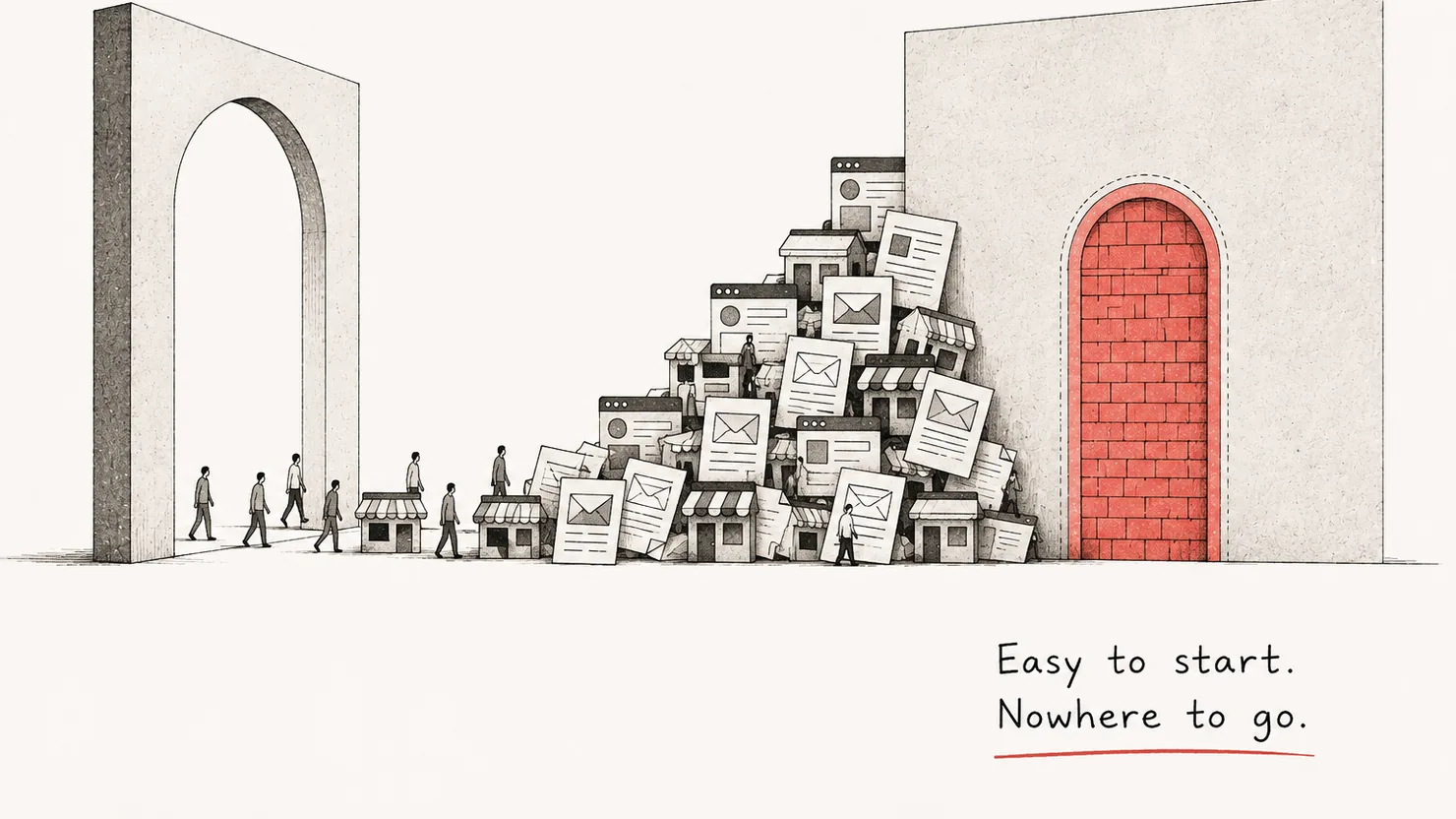
So I went back through fifteen years of pricing pages – archived snapshots, fee changes, the announcements nobody reads – and looked at every platform I could find that tried to make deals under twenty-five thousand dollars work. Nearly every one went up, got expensive, or closed.
Empire Flippers had no stated profit floor until around 2017. Today a business needs $2,000 a month in net profit, averaged over a year, to be listed at all. MicroAcquire launched in 2020 free for sellers, dropped the "Micro" from its name in 2023 and started charging them. Tiny, which set out to be the Berkshire Hathaway of the internet, now starts at $5 million.
Flippa started in 2009 at 5% with a $499 cap. The cap was gone by 2014, and a self-serve sale now costs 10% plus a listing package.
Shopify Exchange let you list a store from about $145. Then, on 1 November 2022, it deleted every listing so it could "dedicate our resources to improving our overall platform". A board built in 2024 to sell pre-revenue projects was asked whether it checked anything. "No we don't! We leave that to buyers." Its server is empty.
These weren't foolish people. Most of them were good at this. The arithmetic beat them.
Here's what a $5,000 sale is worth to some of the survivors today:
What doesn't show up on a pricing page is the work. Checking a $5,000 listing takes almost as long as checking a $100,000 one. On the big deal that work earns tens of thousands. On the small one it earns a few hundred, and only if the deal closes, which most don't.
An economist described the rest in 1970. George Akerlof's paper on used cars, "The Market for 'Lemons'", later earned him a share of the Nobel prize. The seller knows whether the car is good. The buyer can't tell, so the buyer offers the price of an average car. The owners of good cars won't sell at that price, so they leave, and the average gets worse.
Swap the car for an $8,000 side project and the buyer gets a screenshot. A 2021 study sent test traffic to 418 Flippa listings and put the cost of faking it at about 35 cents per thousand visits. The bids rose with it. So the founder with a good small project does the sensible thing and keeps it off the market.
The small end isn't full of bad projects. It's full of projects nobody can tell apart.
What I find hopeful is that the used-car market didn't collapse. Tyler Cowen and Alex Tabarrok pointed out that it was rescued by the odometer and the vehicle history report – things that let the buyer see what the seller sees. By 2012 Americans were buying 40.5 million used cars a year against 14.5 million new ones.
Small internet businesses have their odometers now. Revenue can be read from Stripe rather than a screenshot. Mark Collier went through more than 6,500 Flippa auctions and found that simply linking Google Analytics added about $630 to the average sale. And domain names, which mostly have nothing behind them at all, sell every day. Sedo's median sale in its latest report was $818.
That last one stuck with me. Domains trade because everyone knows what a domain is. Side projects don't, because each one is described from scratch by the person who most wants to sell it.
So when we rebuilt the platform, I went down that list one cause at a time.
A machine reads every listing first now. Anyone can buy that machine. What it knows to look for came from years of reading thousands of listings myself, talking to the people who wrote them, answering support queries, untangling transactions that had gone sideways, doing my own buying and selling, and building software for other people at the studio. Every figure says where it came from – declared by the seller or checked by something outside – and a blank stays blank. A domain, an app with a few hundred users and a newsletter are described differently, because a buyer values them differently. And the small end is the business. Indiemaker is the whole company, and it has been working at this end of the market since 2019.
That's the case. Most of the boards in this piece opened and closed while 1Kprojects, and then Indiemaker, kept going. For most of them the small end was a side door. For us it's the whole house.
1kprojects.com still works, by the way. It points here.
← Back to Notes