We'd just moved into a much bigger house and hadn't furnished it. Most of the rooms echoed. My husband and I shared one as an office: two desks, our Herman Miller chairs, a lot of screens and an old-fashioned filing cabinet, because I hadn't quite made it to paperless yet. Our son was six months old.
I'd already realised that it would be hard to go back to the software studio. It wanted all of me, full time, and I now had a small person who wanted the same. I wanted a business I could keep one foot in while the other foot was busy with a baby.
The advice on offer came in two doors.
The first was passive income. Make a course, write the ebook, and money arrives while you sleep. You've heard the pitch. Most of what's sold behind that door is the door.
The second was the grown-up route. Find an established business, borrow heavily to buy it, and own a job with a loan attached. Real companies, real cash flow, and a lender with opinions about how you spend your days.
Neither fitted a woman with a six-month-old in a house that echoed.
So I went through a third. I'd written "digital asset platform" in a notebook back in 2013 and left it there. Now I went looking for something to buy rather than build. There was barely anything to look at – newsletters with a website attached, no real infrastructure, no market to speak of. I made offers on three. One accepted: 1kprojects, a small site that sold side projects for under a thousand dollars, run by a founder in Morocco. No bank. No broker. Four days of emails, a few checks, a number we both accepted, and an escrow.com transaction – a neutral party holds the money until the buyer confirms they've got what they paid for. It's what lets two people who've never met, on different continents, trust each other for a week.
That was the entire deal structure. Cash, and someone in the middle holding it.
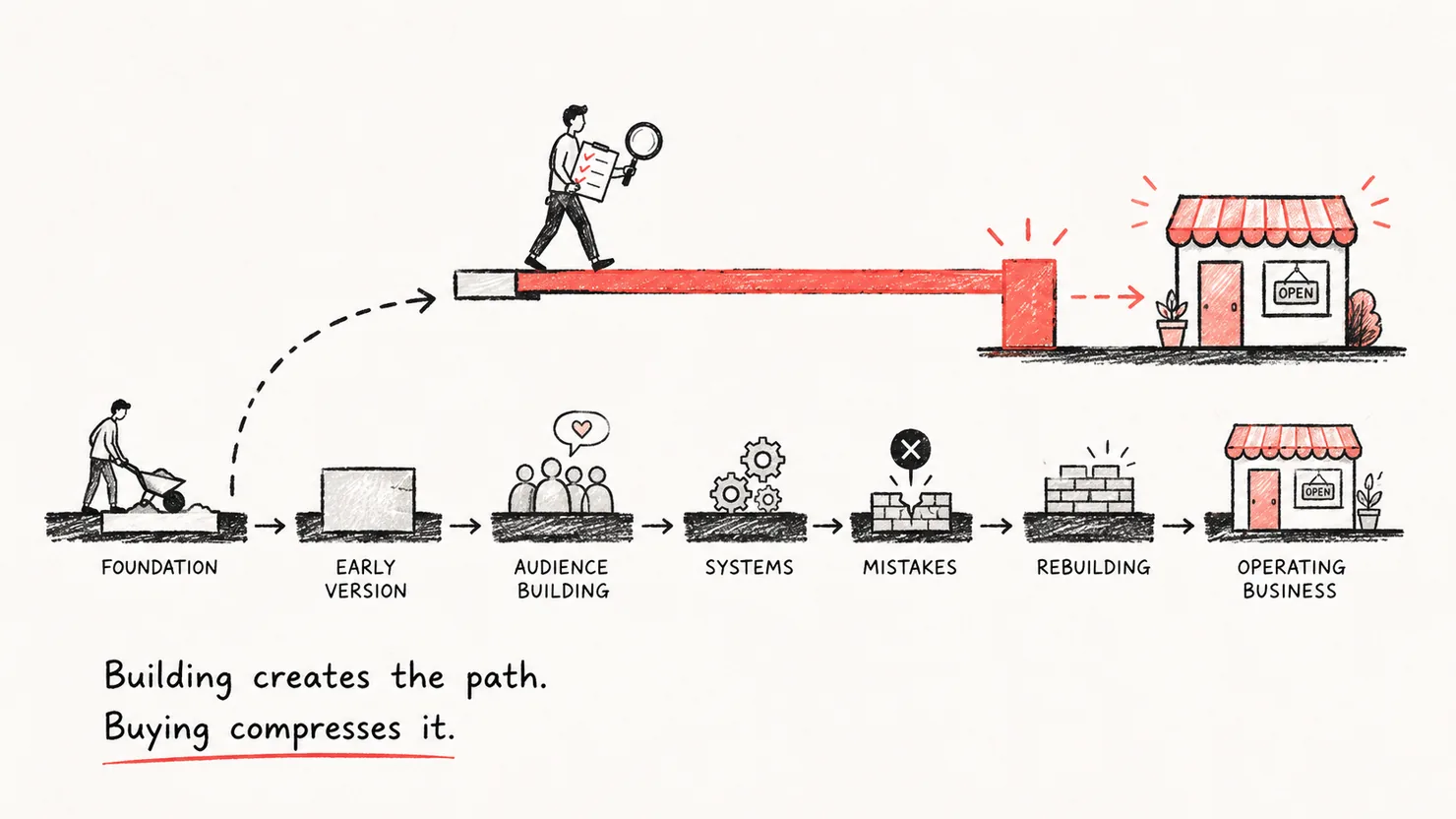
I was not a textbook buyer. No formal documentation, no clean data room. I didn't fret about traffic the way a checklist would tell you to, because I owned a software studio and most of what I might inherit, I could fix. That safety net shaped everything, and not every buyer has one. The question I was really asking wasn't about revenue. It was: can I have this now? Buying shortens a timeline that building can't.
I started with the life – a baby, a studio that wanted all of me, a house that still echoed – and went looking for a business that would fit inside it.
It also made me read a business from the outside for the first time. Why it was built this way. Who the customers actually were. What held the whole thing together. I'd built plenty from scratch, and you never have to read your own work like that.
It had eight hundred users when the money moved. Six months later it had a few thousand.
I've done a fair number of deals since, on both sides of the table. Nobody has ever needed a loan to own a tiny project.
The seller in Morocco had found his way out. Most founders never do. We built the front door and forgot the back one.
None of that makes it easy. After we took over, we were thrown off every payment processor known to man.
If I hadn't gone through that door, I couldn't homeschool our children. I work online, in a field I know well, and that gives me a huge amount of flexibility. I never really left the software studio – I still do work for it from afar. But this is the thing I can sink my teeth into, the one that feels like a worthy pursuit. I could never run a cookie store or a clothing brand. They'd never hold my attention the way this does. It's the idea I could happily obsess over for the next twenty years. I just needed the obsession to fit around my life, not the other way round.
That's the life I was after: work I'd obsess over anyway, on my own terms, from a desk in my own house. I didn't wait to build it. I bought my way in.
← Back to Notes