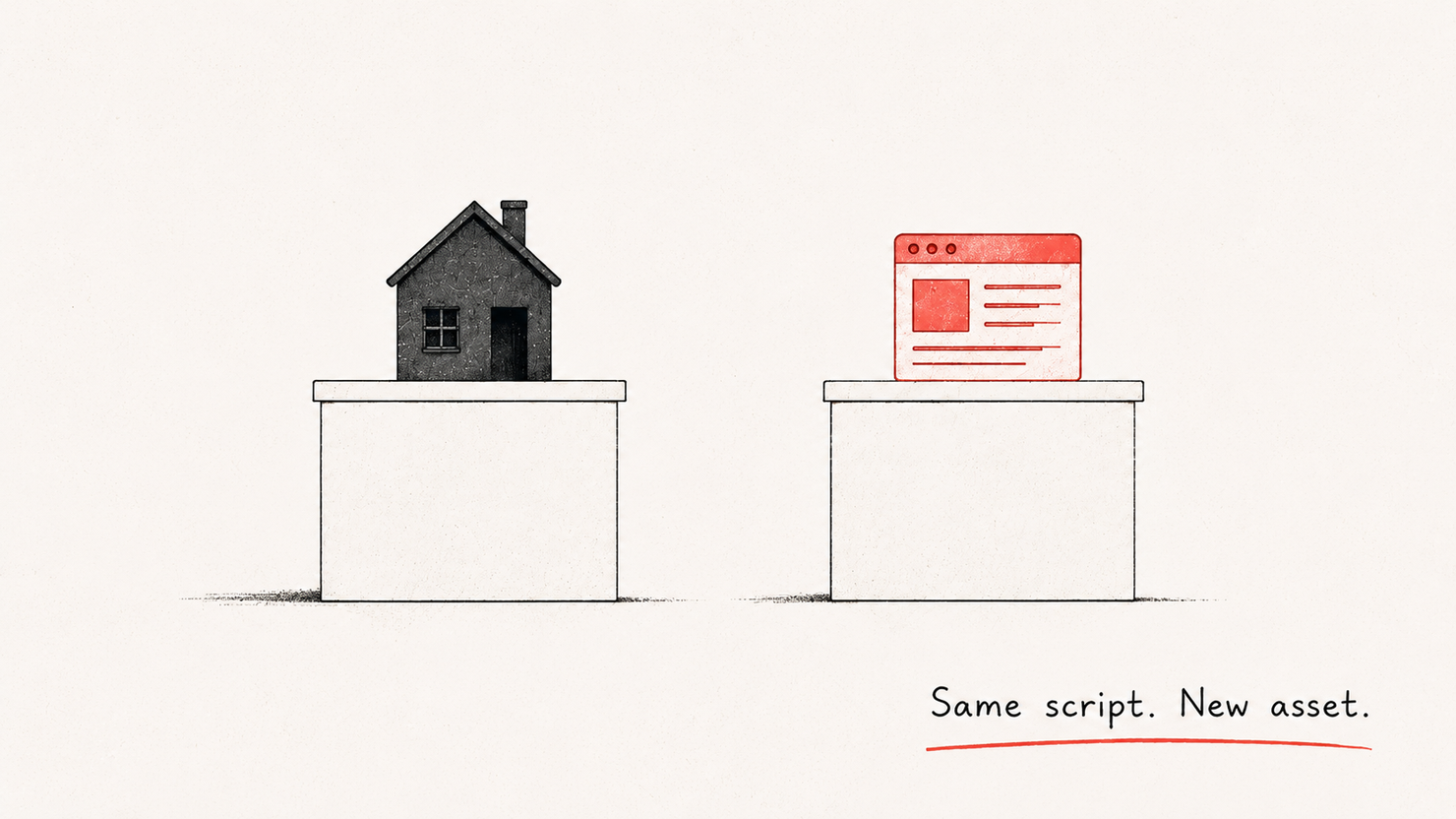
Ask most people where they'd put spare money to work, and the answer is property.
Not shares, not a business, not a fund. Property. A flat to rent out. A second house. Bricks you can stand in front of.
There's a reason for that, and it isn't sentiment.
Property is the one asset class ordinary people understand as an asset. You buy it. It pays you rent. You borrow against it. You improve it and it's worth more. You sell it to the next person, who does the same. The whole thing runs on a script everybody knows, taught by parents, reinforced by every dinner-party conversation about house prices.
Now look at a small digital business through the same lens.
You acquire it. It pays you monthly. You improve it – better onboarding, a price rise, a churn fix – and it's worth more. You hold it for the cash flow or you sell it to the next operator. The script is almost identical. Buy, hold, yield, improve, exit.
The yields are not shy either. A property might return four or five per cent before costs. A profitable micro-SaaS bought at three times annual profit returns north of thirty per cent if it simply holds steady. The numbers aren't a secret. They're just invisible, because nobody narrated them yet.
So the comparison holds further than you'd expect. And then it breaks – in the direction that matters.
Property is bolted to the ground. A digital business is bolted to nothing. There's no geography, no tenant, no boiler to replace at midnight, no council to satisfy, no stamp duty swallowing the first slice of every deal. The capital you need to get in is a fraction of a deposit. The market for what you own is the entire connected world, not the catchment of one postcode.
And it transfers faster. A house sale takes months of solicitors and surveys. A clean digital asset can change hands in weeks, sometimes days, once the books and the access are in order.
There's an asymmetry too that property almost never offers. A rental flat is roughly worth what the flat next door is worth. A small software product, improved by an operator who knows what they're doing, can double or triple in value on the strength of a few decisions. The upside isn't capped by the street.
The thing standing in the way is not the asset. It's the script.
Property became the default because the path was legible. Everybody knew how to value it, finance it, transfer it, talk about it. Digital businesses have all the same mechanics and almost none of the shared language. No one taught you that a newsletter with stable revenue is an income-producing asset you can buy. So you don't think of it as one.
That's a gap in narration, not a gap in reality. And narration can be built.
When buying a profitable digital business feels as ordinary as buying a buy-to-let, the audience for this work won't be founders and operators. It'll be everyone who currently reaches for bricks.
Tiny businesses might become the new real estate. The asset was always there. We just hadn't named it yet.
← Back to Notes