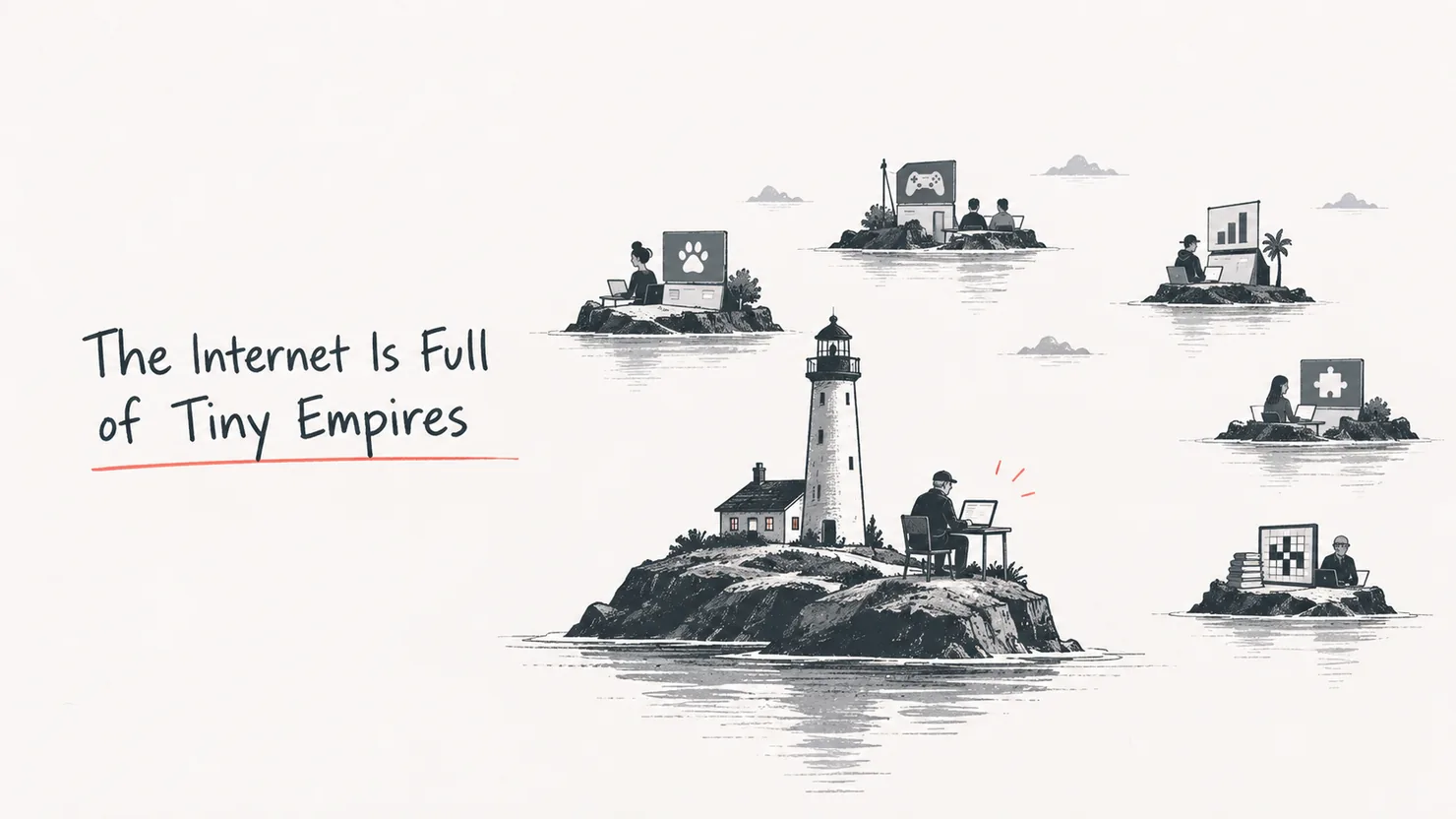
Somewhere right now, a man in his sixties is updating a website about lighthouses.
He's run it for nineteen years. It has every lighthouse on a particular coastline, photographed, dated, cross-referenced, with a forum where retired keepers and obsessive tourists argue about lens types. It earns him a few thousand a month from a single sponsor and a tasteful affiliate link to a boat-tour company. He answers every email. He is, in the most literal sense, the world authority on his subject.
You will never hear his name. He is also running a better business than most funded startups.
The internet is full of these. Once you start looking, you can't stop seeing them.
There's the woman who built a booking tool for dog groomers because her sister couldn't find one that worked. It serves four thousand small salons now. She has no investors, no staff beyond a contractor in another timezone, and a product so specific that no big company will ever bother to compete for it. She takes August off.
There's the couple who run a newsletter about a single video game. Thirty thousand subscribers who have read it for a decade. It pays for their life in a small town and a slightly absurd amount of travel to gaming conventions, where they are treated, gently, like minor royalty.
There's the teenager who flips domain names and already understands liquidity better than people three times his age. The retired teacher whose crossword app outlives most of the startups founded the same year. The pseudonymous account selling one beautiful, ferociously well-made plugin to a niche that adores it.
None of them are trying to be unicorns. That's the part the mainstream story keeps missing.
These aren't failed attempts at something bigger. They're complete. Each one is somebody who found a small, real thing that the wider economy is too clumsy to serve, and served it well, and built a life on top of it. A tiny empire – sovereign within its borders, indifferent to the borders of anyone else.
What they share is not scale. It's a kind of quiet mastery. They know their customer the way you know an old friend. They've earned a trust that no ad budget can buy and no competitor can shortcut. The business is small precisely because the founder chose depth over reach, and got rich enough, in the ways that mattered to them, on the trade.
Spend a while among these operators and your sense of what counts as success gets recalibrated. The dashboard metrics fall away. What's left is more human: did you make something people genuinely needed, did it pay for the life you wanted, are you free.
That's the whole batch closing the loop. The asset class, the small teams, the missing exit – they all come back to this. Real people, building real things, mostly out of sight, running the long tail of the entire economy.
The internet is full of tiny empires. Most of the value online was never the giants. It was them.
← Back to Notes