I caught sight of her face before I heard her voice.
Then her body language. Then the panic. Then the tears.
It was one of those moments where your brain reaches a conclusion before anyone says it out loud. She was about to have the worst day of her life.
Time does strange things in a moment like that. Minutes stretch. Conversation turns to background noise. Every movement in the room seems to matter.
Then I heard the paddles.
I didn't know the man. I spent most of those forty-five minutes thinking about his wife.
The room filled with doctors and nurses moving in and out with the quiet urgency of people who know this moment matters. Every instruction measured. Every movement deliberate.
Except for one voice.
"Do not touch the patient. Stand clear."
The defibrillator repeated its phrases with perfect clarity. Calm, precise, and entirely without humanity.
The talking machine began with doctors. The first automated defibrillator was built in Oregon in the early 1970s by two physicians and an engineer, and it was the one that established the voice – the idea that a machine should walk you through it, now standard on every unit. People who had held dying patients decided the machine should speak. What none of them could choose was how it would feel to hear it.
Because that voice could read a rhythm. It could advise a shock. It could tell them when to stand back.
It couldn't acknowledge the fear in the room. It couldn't tell anyone they were doing everything they could. It couldn't comfort a wife.
And yet every time it beeped, there was hope. Not because of what it said. Because silence would have been worse. That was the part I didn't expect – I could resent the flat little voice and cling to its noise at the same time. Comforting and useless in the same breath, and I couldn't pull the two apart.
I sat with that contradiction, because I love technology. I've spent much of my career building software, and I believe AI will be one of the most important tools we ever make. That flat little voice is the whole of it in miniature – a machine that does its one job perfectly and cannot do the other thing at all. That is the argument about AI, already sitting in the room, decades before we had the word for it. None of that was in question in that room. The machine did exactly what it was built to do. What stayed with me wasn't about the machine at all. It was about us – what we choose to build, and what we choose to carry ourselves.
Because a few feet away, life carried on almost untouched.
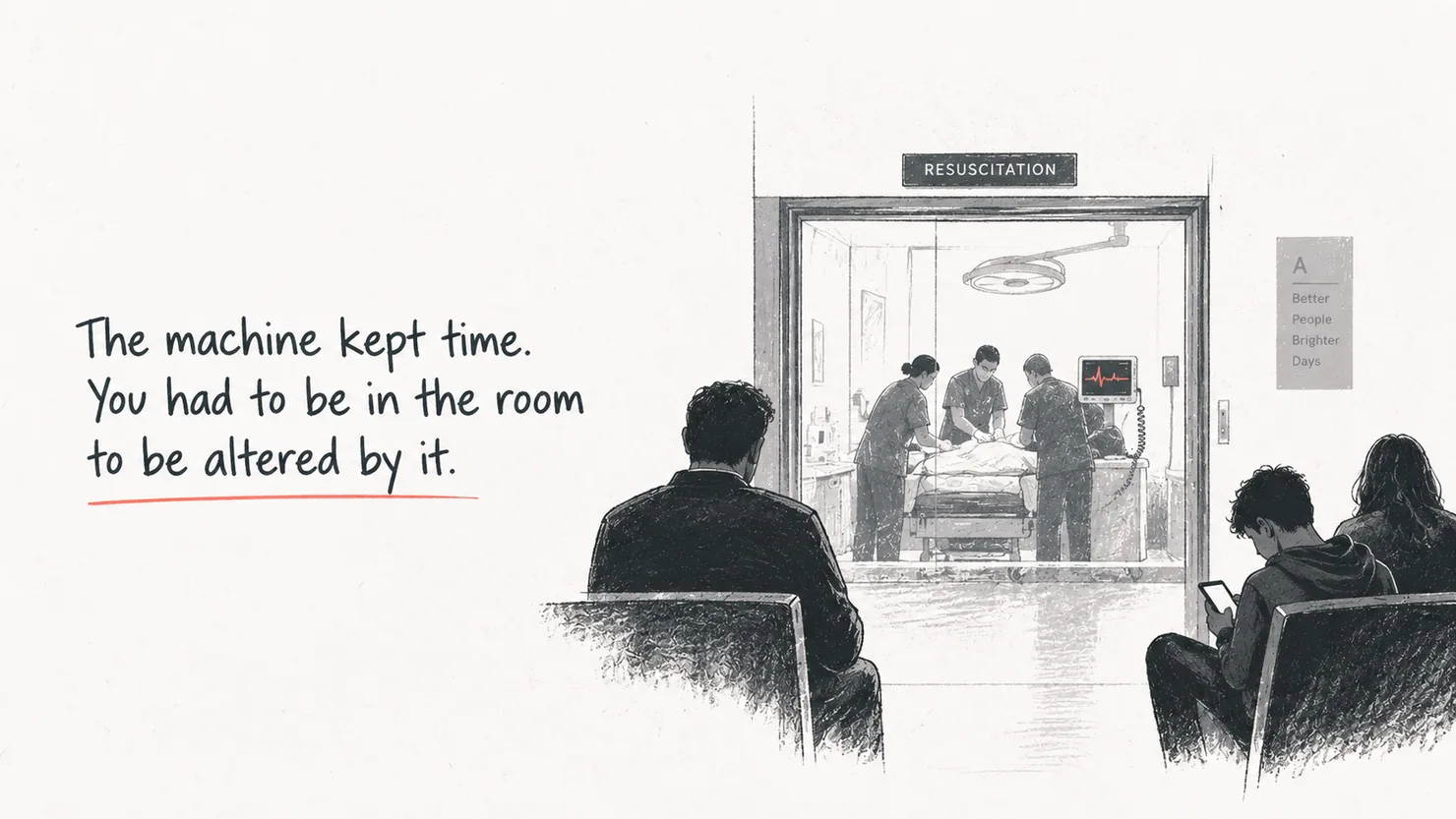
Two teenage boys complained about waiting. Their mother shrugged and said that's just how it is. The man beside me played Solitaire on his phone.
Nobody was doing anything wrong. But nobody was choosing to be there, either. Each had picked the world inside a rectangle of glass over the room they were actually sitting in.
This is the part we get wrong when we blame the machines. The phone doesn't steal your attention. You hand it over. We are choosing, more and more, not to spend ourselves on the people in front of us, on community, on the plain fact of being somewhere real. The technology only offers. We decide.
My son is half the age of that whining boy. If it had been him, I'd have been brutal about it. Sit down. Be quiet. Watch this. Listen to those paddles – that is the sound of life being short.
I'm not proud of the instinct. I stand by the lesson. Presence is one of the few things worth being brutal over.
Because here is what the machine reminded me. Technology can carry almost anything now, except the things that were only ever ours.
Which is how I use technology, and how I'll keep using it. Let it do the job, so I have more energy, time and presence for the part of life that matters.
It can process information. It cannot shoulder grief.
It can optimise a decision. It cannot stand beside someone whose world is collapsing.
It can tell a doctor the exact moment to shock a heart. It cannot tell a wife that her husband mattered.
The risk was never that the machine couldn't do these things. It was never meant to. The risk is that we grow so used to handing things over that we hand these over too – and stop choosing to show up for them.
That machine beeps for exactly as long as it's told to. When it finally goes quiet, what's left in the room isn't information. It's people who have been changed – the wife most of all, and everyone who was truly there. An experience like that rewrites the reality of the people who live through it.
But only if you live through it. The ones behind the glass walked out exactly as they walked in. Untouched, and so unchanged. That is the real cost of not showing up – not the moment you miss, but the person you don't become.
The machine kept time. You had to be in the room to be altered by it.
← Back to Notes