Recently I got my son a map app. A geography quiz: countries, capitals, flags, the sort of thing that sits on a required list for some grade we haven't reached yet.
It worked better than any teaching I've done. He was hooked, learned fast and built up a score. There are many things he'll forgive me. Messing up that score would need more than ice cream.
The current map wasn't enough; it had to be the world in 1935. And because we are peculiar people, he started lining up what each country spent on its military against how many people it lost in wars. The score kept going up.
I did not see that coming.
Getting him the app took about a minute.
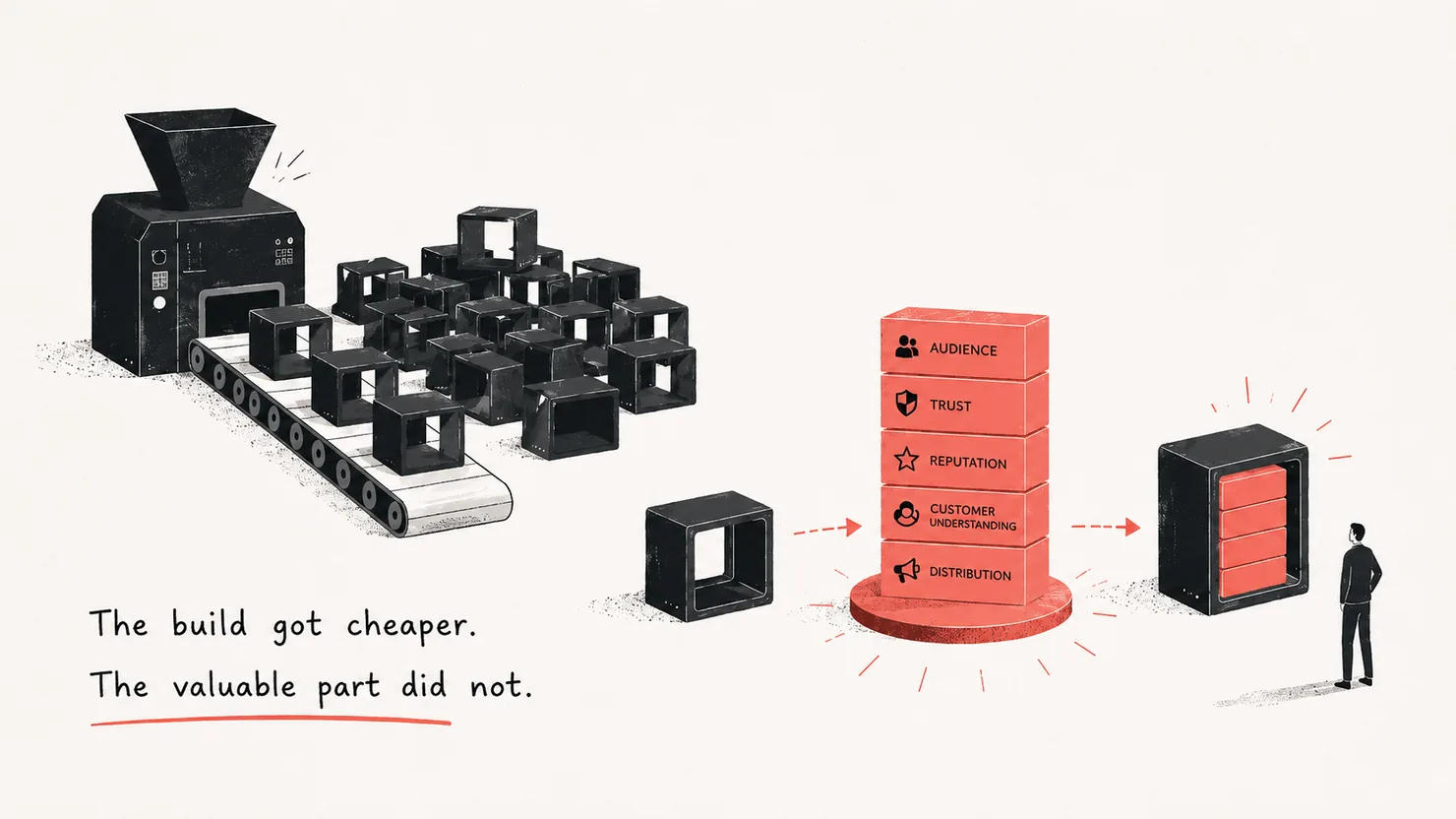
You can buy the start of almost anything now, and have it by this afternoon. A campaign idea in thirty seconds. A logo, a landing page, a waitlist.
For most of my working life the start was the expensive part. Getting from nothing to something took months, and the months did a second job: they sorted the people who meant it from the people who liked the idea of it. A working first version proved something.
That filter has gone. A first version is a purchase now, and a purchase proves you had the subscription.
I've spent a large part of my working life building things that no longer exist. Businesses, sites, clever little tools – gone, most of them, without a trace you could point to. They fed us and taught me everything. I was almost never asking what I was making that would still be here.
The thing that lasted was the one we didn't think anyone would use.
Years ago, under the company name we had before this one, we released a small PHP library that checks data before it goes anywhere it shouldn't. People still use it. Any decent model could write it before the kettle boils, so if someone bought it tomorrow, the code would be the cheapest part of the deal. They'd be paying for the years: the projects built on top of it, the bugs strangers found and fixed, the fact that it has run long enough to be boring.
I've built on open source for most of my career. Linux, PHP, MySQL, Laravel, WordPress, thousands of packages kept going by strangers who asked for nothing back. None of it came out of a weekend sprint. You can ship faster. You cannot trust faster.
Whenever something useful is slow to make and somebody has already made it, a market turns up. Domains is a good example. A good name can't be manufactured, only found, and each one can be registered exactly once, so a whole trade grew up around something that costs a few pounds a year to keep. Economists have a word for money earned from holding something scarce rather than producing anything: rent. The landlord would recognise it.
Small online businesses are the same trade, one layer up. Indiemaker is built around that trade, so we sort everything by the part that took time. The Earning shelf is months of revenue a buyer can check at the source. Traction is the users who stayed, the newsletter people still open, the search traffic that took years to rank. Built is the product itself, rated on the evidence of what's in it rather than the seller's word for how long it took. Domains are names, because a good one can only be found. A clever wrapper with no users is just a feature waiting for whoever already has the customers. Sometimes it's only the name. I once sold a brand and kept the software.
What a buyer pays for is somewhere to start, and the price is the road they don't have to walk. A newsletter with three thousand readers is worth whatever it would cost you to reach three thousand readers from where you stand. If you have none, that's a couple of years of writing into silence. If you already have thirty thousand in the same niche, it's a rounding error with an unsubscribe link. Same newsletter, same asking price, two different purchases. Most buyers compare the asking price with the revenue. They should be comparing it with the distance.
So you can buy the start of almost anything, and more and more you can buy other people's years. The app took me a minute to get. The score took him ages, and it's the only part of the whole thing he'd fight me for.
Then he put the 1935 quiz in front of me and asked me to fill in the country names. Halfway through, he got so worried I'd wreck his score that he took hold of my hand and started steering it.
"Noooooo, it was 1935!"
← Back to Notes