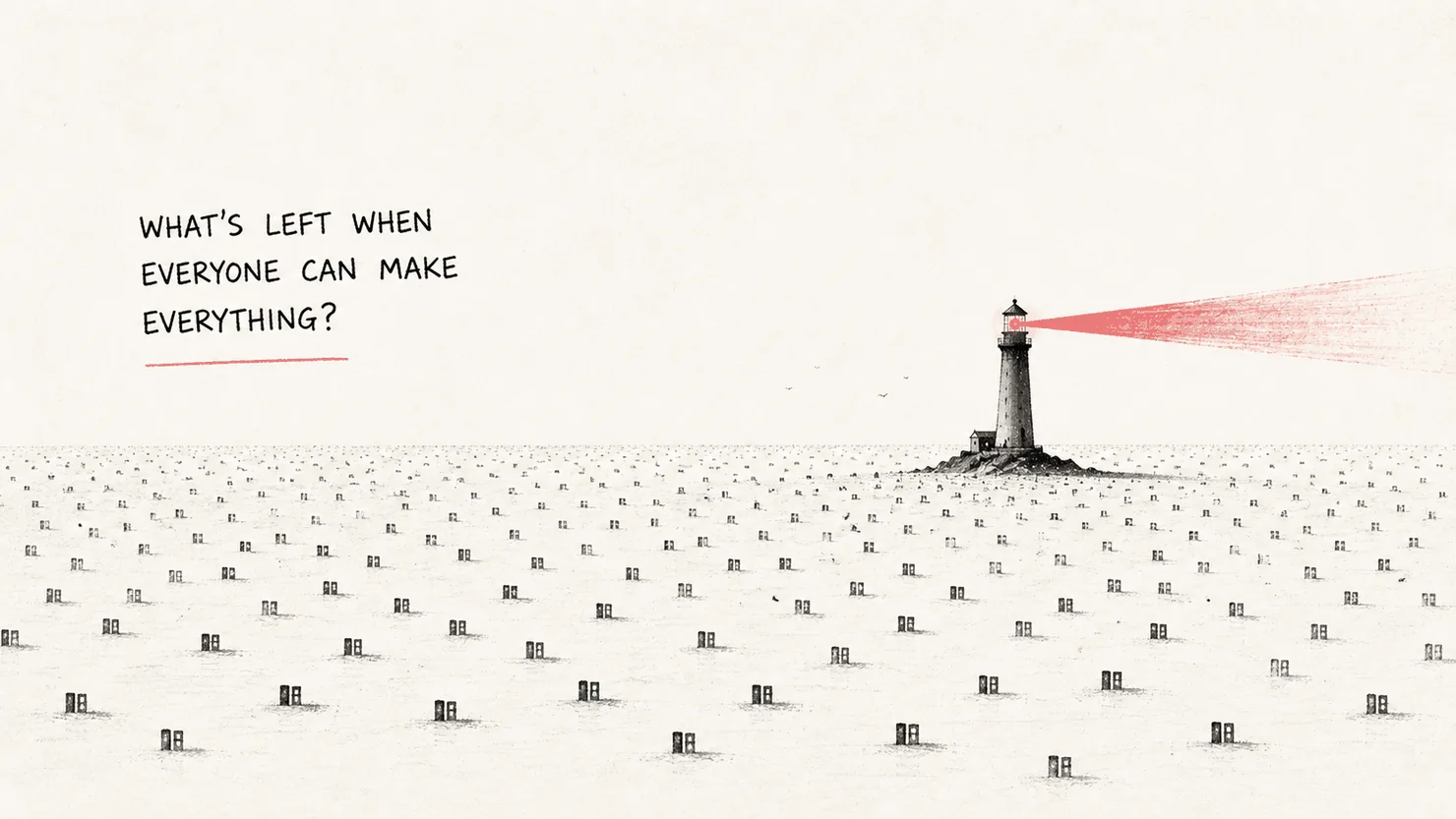
For most of my working life, the edge was knowing more than the person across the table.
Not by much. Just enough. The one who'd read the contract properly, or understood how the payment rails worked, or knew what a business was actually worth versus what the seller hoped. Knowledge was the moat. You spent years accumulating it, and it paid you back for decades.
That's ending. Not slowly, either.
Soon everyone has the analyst, the lawyer, the strategist, the coder – all of them, instantly, for the price of a subscription. The answer is no longer scarce. Ask the machine, and it knows more about SaaS multiples than I've picked up in sixteen years of doing the deals. That should probably bother me more than it does.
So here's the question I keep turning over. When intelligence costs almost nothing, what's left that's worth anything?
I think it's capital. Not the money kind, or not only. The human kind. And I think it splits into a handful of things that AI can't hand you, no matter how good the prompt.
There are five. But I'll tell you now, I don't think they weigh the same.
The first is judgment. The machine will give you a thousand options and rank them beautifully and it still can't tell you which one is worth your one wild life. It doesn't know your constraints, your appetite, the deal that'll keep you up at night versus the one that'll bore you into quitting. Choosing well is a skill, and it's getting rarer precisely because everyone now has the same thousand options in front of them. Judgment is what you do with abundance. Most people drown in it. And it can't be bought. Only built.
The second is trust. AI is extraordinary at sounding expert. It is terrible at being trusted, and those are different animals. When half of what you read might be synthetic, the person with a real track record – who did what they said, who told you the boring truth when the exciting lie was right there – becomes worth a premium. I've bought businesses partly on the strength of a seller I believed. I've walked from better numbers attached to people I didn't. That instinct is about to be worth a lot more, not less.
The third is your network, though I'd put it more plainly than that. It was never how many people you know. It's how many would pick up the phone. As the cost of making things falls to nothing, the cost of being genuinely known by good people stays stubbornly, wonderfully high. You can't prompt your way into someone trusting you at two in the morning.
The fourth is execution, and this one people underrate because it's unglamorous. Ideas were never the scarce thing – ask anyone who's sat in a pub listening to a mate describe the app that'll change everything. Now ideas are cheaper still. What's rare is the person who ships the ugly first version, writes the piece, closes the deal, launches the thing that isn't ready. AI makes builders faster. It does not, whatever the noise says, make them out of people who won't build.
Those four matter. But there's a fifth, and it's the one I actually came here to say.
Ownership.
Here's the whole argument in three sentences. The person using AI to build software is useful. The person who owns the software business is building wealth. The person who owns twenty small digital assets, each one improved by a machine that costs less every quarter, is building something the first two don't have – leverage that compounds while they sleep.
I know the shape of this because I've lived it. I'd built businesses for years by then – a software studio I'd run for close to a decade, and before that a promotions company and a corporate gifting and branding business. But the first one I ever bought rather than built was a small thing, more project than business: a directory with a newsletter and a list of buyers and sellers. I bought it by wiring money to a man I'd never met, in another country, on the strength of four days of emails. It was real, and it was mine the moment the money landed. Buying something that already worked felt nothing like building it – and everything I think about owning began there.
That's the shift underneath the shift. Industrial work paid you for your hours. The information age paid you for what you knew. This age pays you for what you own, because owning is the one thing the machine makes better without ever being able to do for you. It'll help you build the asset. It'll run the asset. It will never own the asset. That line stays yours.
Though the tidy version hides something. None of these – judgment, trust, the instinct to own rather than rent – comes with the subscription. They're built in a person slowly, over years, mostly by doing hard things badly until you can tell the difference between an answer that's right and one that only sounds right. That isn't a question about business. It's a question about how you raise a person – and it's the one I think about most now, the part of all this that has almost nothing to do with the machine.
So when people ask how to get ahead of AI, and they mean should they learn to prompt better, I think they've got hold of the wrong end. Getting good at using the tool is table stakes now, like knowing how to use a spreadsheet. The real question isn't how well you can make things. Everyone can make things.
It's what you own when the making is done.
← Back to Notes