I left school early and did the last years of high school by correspondence, back when that meant faxing my assignments to a marker I never met. Both my parents worked in education, which matters to the story. Progressive, but never ideological about it – pragmatic, mostly. At fifteen they let me do the thing I actually wanted to do, and they did it from a place of opportunity rather than rebellion. Not getting me away from something. Pointing me at more of it. That's the whole difference, really: a child raised in reaction, or a child raised in possibility.
So when I say I'm schooling my kids differently for a world that hasn't arrived yet, know that I'm second generation at this. My parents gave me the room early. I'm giving my kids the same, with a slightly clearer view of what's coming – it's my actual job now to watch where the technology goes.
I've never had a career, not in the way most people mean it. I've built businesses, run a software studio that built the digital side of other people's companies, bought and sold things, spent a lot of time in the grey areas where nobody hands you a title or a ladder to climb. I've never once applied for the next rung up. There wasn't a rung. There was a run of things worth doing and the nerve to do them without asking. Twenty years of that teaches you the conventional path is optional – and I've been right often enough to keep trusting the lesson.
I make bets for a living and most of them don't cost me any sleep. This one does. The day I pulled my children out of school I became the person on the hook for how they turn out. Not a teacher. Not a system. Me. It's made me think about my own mortality more than I'd strictly like – I do all the health checks now, the ones I used to skip. I'd rather be around to find out whether I got this right.
The cost of thinking is collapsing. Analysis, writing, code, diagnosis – the whole apparatus of clever cognitive work – a machine will do it faster and cheaper and, more often than we'd like to say out loud, better than a trained human. Not in some far-off year. My kids will grow into it the way I grew into broadband, and I grew into broadband from a house with a fax machine in the hall.
It's tempting to think that cognitive skill is now a waste of a childhood. Why drill mental arithmetic, why labour over an essay, why grind through a hard proof, when the machine does the lot on request? Outsource the thinking. Free the child up for something better. But that's not how humans develop.
What I'm actually preparing them for
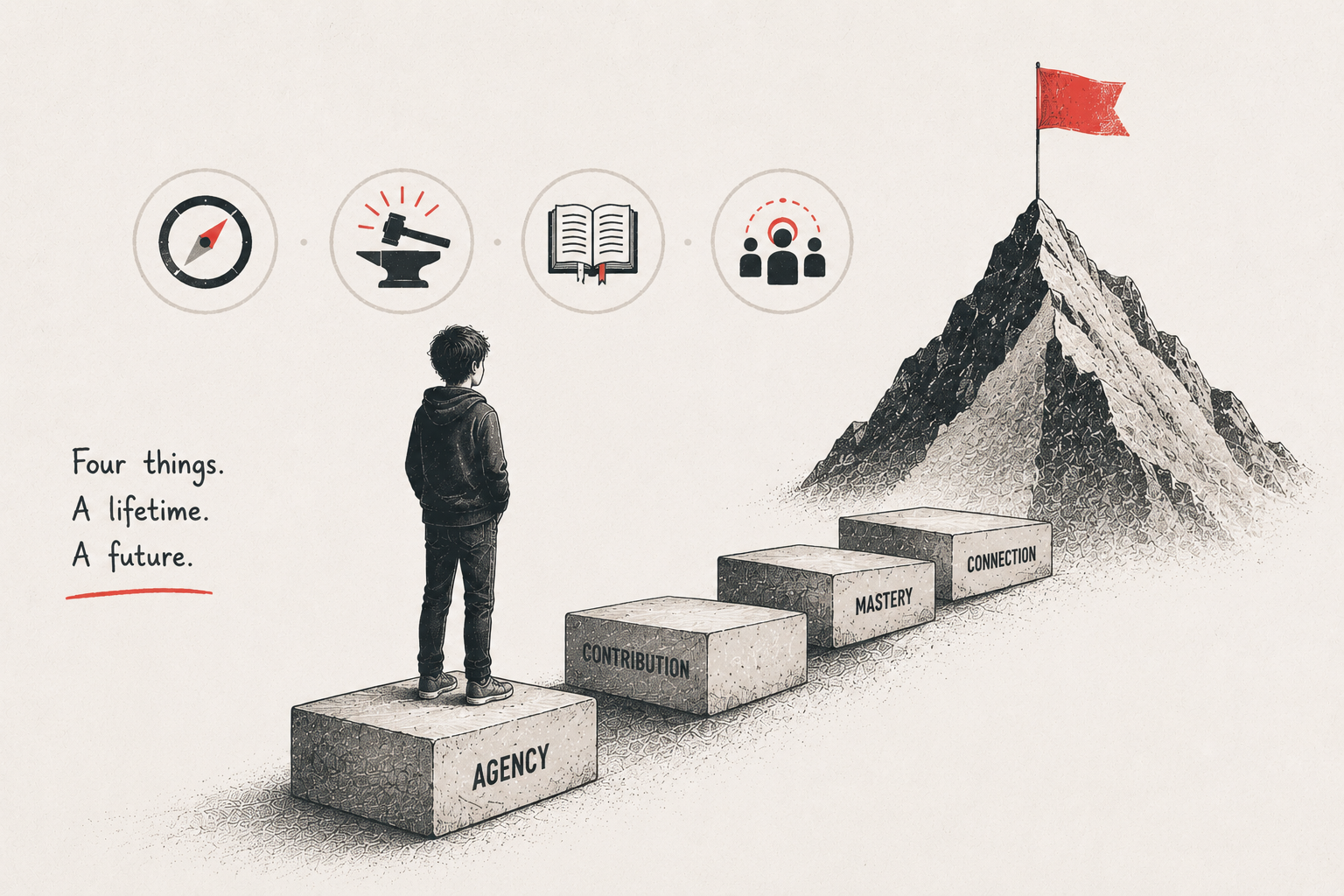
Strip it back and a person needs four things: agency, contribution, mastery, connection. Some people get them from a career. Some from raising children with no salary attached. A serious amateur gets them. So does a volunteer, or someone buried happily in a craft or a faith or a patch of community. What I'm preparing my children for is the ability to build those four things themselves, in whatever shape the world settles into.
One thing I want to be clear about, because it's the part I care most about. None of this is me closing doors. I want my children able to walk into any university they like, if that's what they end up wanting. Every option open. None of it quietly lifted off the table by their mother's worldview. What I distrust is conformity – doing a thing because it's the path, not because it's right for the person standing on it. So the doors stay open. The choosing is theirs. That's exactly what my parents did for me, from that same place of opportunity, and it's the piece I most want to hand on.
The thing the machine can't take
It starts, oddly, with making them think much harder than they'll ever strictly need to.
Watch the people getting the most out of these tools right now. The ones who use them well aren't the ones who skipped learning to think. They're the ones who did the hard cognitive work for years and can now tell, at a glance, the difference between a good answer and a merely plausible one. They have taste. They have judgment. They know what they're looking at.
There's no shortcut in. Taste isn't handed to you – it's residue. It's what's left in the bottom of you after you've made a hundred things badly and worked out, slowly, why each one was bad. Judgment is the same. It's the deposit a hard problem leaves behind long after you've forgotten the problem itself. Take away the struggle and you pour off the sediment with it. What you're left with is a child who can summon any answer on demand and can't tell a true one from a confident lie.
The scarce human skill is discernment. Knowing what's good, what's real, what to ask for and what to bin. And discernment is built, start to finish, out of exactly the cognitive labour everyone is now so keen to skip.
Discernment has a sister, and her name is noticing. Seeing the thing the whole room walked straight past – the odd detail, the pattern nobody's bothered to name, the question that simply hasn't occurred to anyone. It comes from a mind that watches things for no particular reason, and that kind of attention is about to get very rare. Scrolling kills it early. The world arrives pre-chewed, and a mind fed that way quietly forgets how to look. So I guard the looking. I let them stare at things. I ask what they noticed before I ever tell them what I did.
So I make my children do the hard thing. Not so they can do it by hand as adults – they mostly won't need to.
What I actually do
You'd expect a mother prepping her kids for an AI world to fill the house with more technology. I've gone the other way entirely. Screens come last, after everything that actually assembles a person: a body that can do hard things, the ability to sit inside a difficult feeling without bolting for the exit, the nerve to try the thing that might not work, the stubbornness to stay with it when it does, friendships that take years to lay down, ordinary physical health, and all that curiosity and taste and judgment I've already gone on about. Get those in and the technology takes an afternoon to pick up. Get them wrong and no amount of technology puts them back.
Skills are lego blocks, and more blocks is always better. They're growing up in a world with creation sitting dead centre, so we let them create. Imagine a thing, make the thing, whatever shape it wants to take.
Creation over consumption – and the ability to actually think – means no social media. No short-form anything, and I do mean anything. Long-form only, from the reading to the films. A child raised on real literature soaks up ethics and philosophy and empathy without a single lesson ever labelled as such. You learn what a life costs by living a hundred of them on the page. And I lean towards the inspiring: what the world could be, what happens when people pull together. Not the endless Netflix parade of dysfunctional families and societies falling over. The reading holds up everything else.
Then the non-negotiables. Maths and language arts. One instrument. One international language. Learn to speak in public without dying. Learn to draw, because it's how you say things when words won't do it. And be fit.
The rest is mostly me setting a problem and then getting out of the way. Six mechanical mechanisms run the physical world – learn one a week, then build me each of them. I hand over the fundamentals and turn them loose.
I like game theory. I dislike, intensely, the idea of children unplugged from reality. So: three games, capped at fifteen minutes a day between them. One world-building simulation, one for brain puzzles, one for meditation. That's the lot. We're fond of a Synthesis camp, where kids get dropped into complex team games and nobody tells them the rules or what to think. They have to make sense of the chaos, get aligned with children from the other side of the planet, make a plan, watch the plan fail, and correct with the clock running down. Mistakes don't get punished there. They're the raw material.
None of it teaches answers. It certainly doesn't teach test-taking. It teaches them to hold their nerve inside a problem they don't understand yet, alongside people they didn't pick, and find the way through together anyway. That isn't a school subject. It's the shape of every hard thing they'll ever do – build a company, hold a marriage together, raise their own children, fix the thing nobody's fixed before. The machine can hand them any fact going. It can't hand them the composure to stand in the confusion long enough for a plan to show up. That gets practised, or it doesn't. And it's best practised young.
I let them be bored. Boredom is where a mind learns to make its own weather instead of waiting to be handed some. I let them get things wrong and sit in the wrongness long enough to actually feel it, rather than rushing in to rescue them into the right answer. I ask what they think before I let them look anything up. And I make them finish the hard things – the maths that resists, the bit of writing that refuses to come out right – because finishing is where the deposit forms.
And I keep them present – actually in the room, and in their own attention, rather than scattered thinly across a dozen feeds. Presence used to be the default setting of a childhood. It's turning into a discipline, so we practise it like one.
If I had to keep one and burn the rest, it's agency. The settled, bone-deep belief that you can work a thing out for yourself – that not knowing yet is a starting line, not a wall. That's the whole difference between the child who builds and the child who scrolls, and if I'm honest with you, everything else here is really just in service of it.
That's a bet too, obviously. But it's the one bet where I already know how the technology ends. The machine takes the thinking. It can't touch what the thinking made of you.
That's the part I'm building. Quietly, at a kitchen table, one resisted answer at a time.
← Back to Notes