The last thing I wrote argued that some assets are worth owning and most aren't. An audience. Trust. Distribution. The things that don't fall in price when building does.
That's true, but it's only half the picture, and the missing half is the more interesting one.
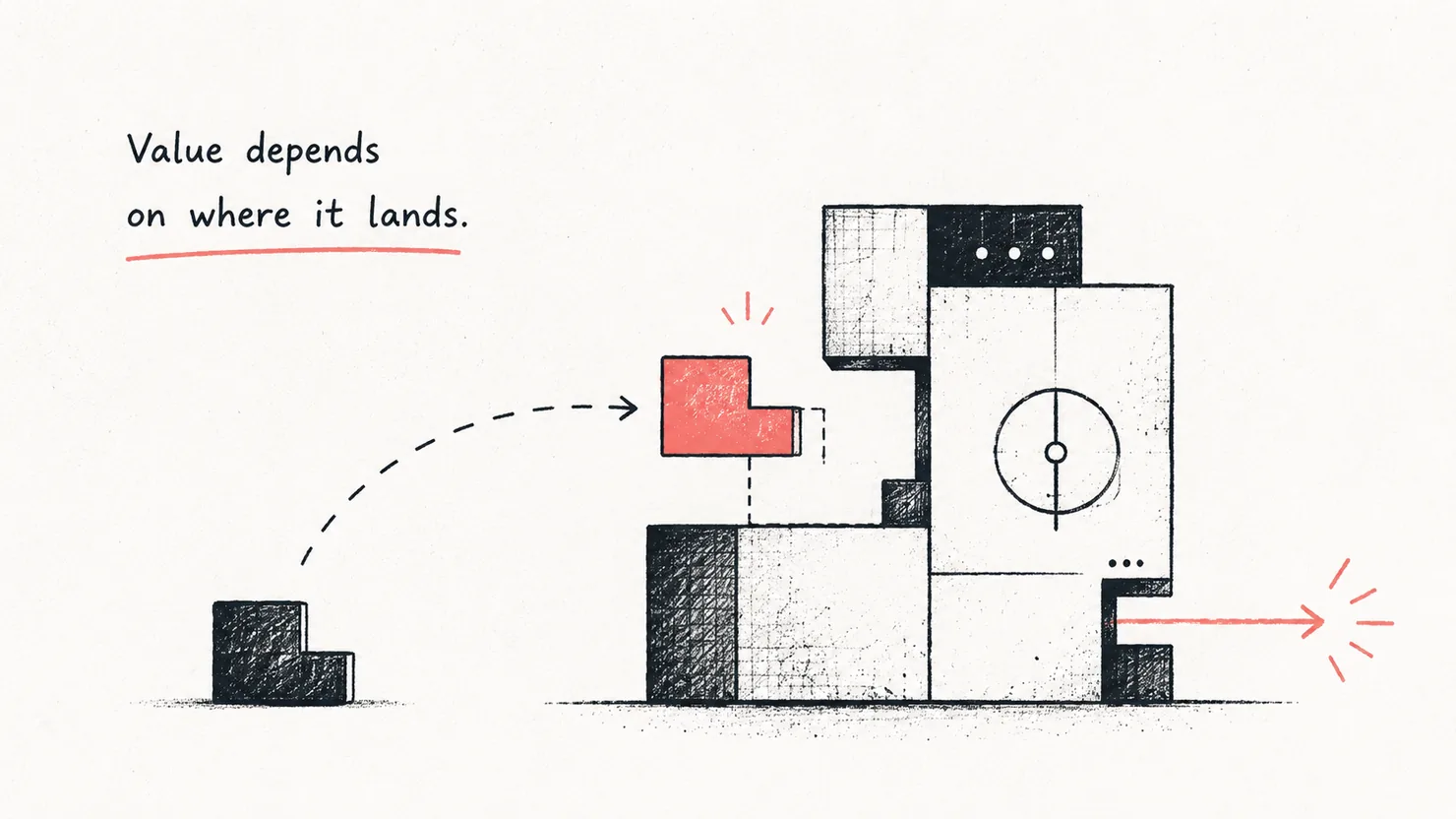
Worth isn't a property of the thing. It's a relationship between the thing and the person standing next to it.
The same asset is gold to one person and dead weight to another. A dormant newsletter with four thousand subscribers is a chore to the founder who's lost interest and a launchpad to the operator who has a product those four thousand people would buy. Nothing about the asset changed. The person next to it did.
This is the part of dealmaking nobody quite says out loud. You're not hunting for things that are valuable. You're hunting for things that are valuable to you and cheap to whoever's holding them. The gap between those two numbers is the entire game.
Which means the edge isn't capital, and it isn't even taste. It's recognition and speed. Seeing what something is worth in your hands before the seller does, and moving before the next person sees it too.
Let me make that concrete, because in the abstract it sounds like a platitude.
A micro-SaaS doing four hundred a month is going nowhere for its founder, who built it, got bored, and stopped marketing. To someone who already runs a product in the same niche, it isn't a four-hundred-a-month business. It's a customer list, a working integration, and a competitor removed – bolted onto distribution that already exists. Same numbers on the listing. Completely different worth.
A failed marketplace that never reached liquidity is worthless as a marketplace. But the seller spent two years building supply relationships, and to someone launching into that exact space, the supply side is the hard part they were dreading. They're not buying the marketplace. They're buying the year of relationship-building they'd otherwise have to do themselves.
A content site gutted by an algorithm change is a falling knife to most buyers. To someone who knows the niche is about to matter again, or who has an email strategy that doesn't depend on search at all, the traffic collapse is the discount, not the problem. The crowd sees a dying asset. They see mispriced inventory.
An expired domain is the cleanest version of this. Inert to almost everyone. Perfect to the one person building the thing it exactly names.
It scales up further than people think. A small team that's poured two years into a startup that never quite took off will often conclude there's nothing to sell. They never registered a company, or they did and it's dormant, and "exit" sounds like a word for other people with lawyers and term sheets. So they walk away and let it rot. But the thing they built – the code, the users, the integrations, the two years of hard-won understanding of a problem – is exactly what someone in an adjacent space would pay real money to skip ahead and own. The team couldn't see an asset because they were looking for a company. There wasn't a company. There was an asset the whole time, and it was worth most to someone who wasn't them.
In every case the asset sat there meaning one thing to its owner and something entirely different to the right buyer. The skill was never spotting value in the abstract. It was spotting the mismatch – and being quick enough to act on it before the mismatch closed.
That's why "what's worth owning" can't be a fixed list. The list shifts depending on what you already hold. If you've got distribution, you should be looking at every undistributed product as half-finished in your favour. If you understand a niche better than the market does, every asset the market has written off in that niche is a question worth asking. Your existing position is the lens that makes some things look like treasure and others like junk – and the same object can be both, to two different people, on the same Tuesday.
So the real work isn't building a portfolio of obviously good things. Obviously good things are expensive, because everyone can see them. The work is knowing your own position well enough to recognise what's underpriced from where you stand.
The opportunity is rarely the thing everyone agrees is valuable.
It's the thing only you can see is valuable to you.
← Back to Notes